
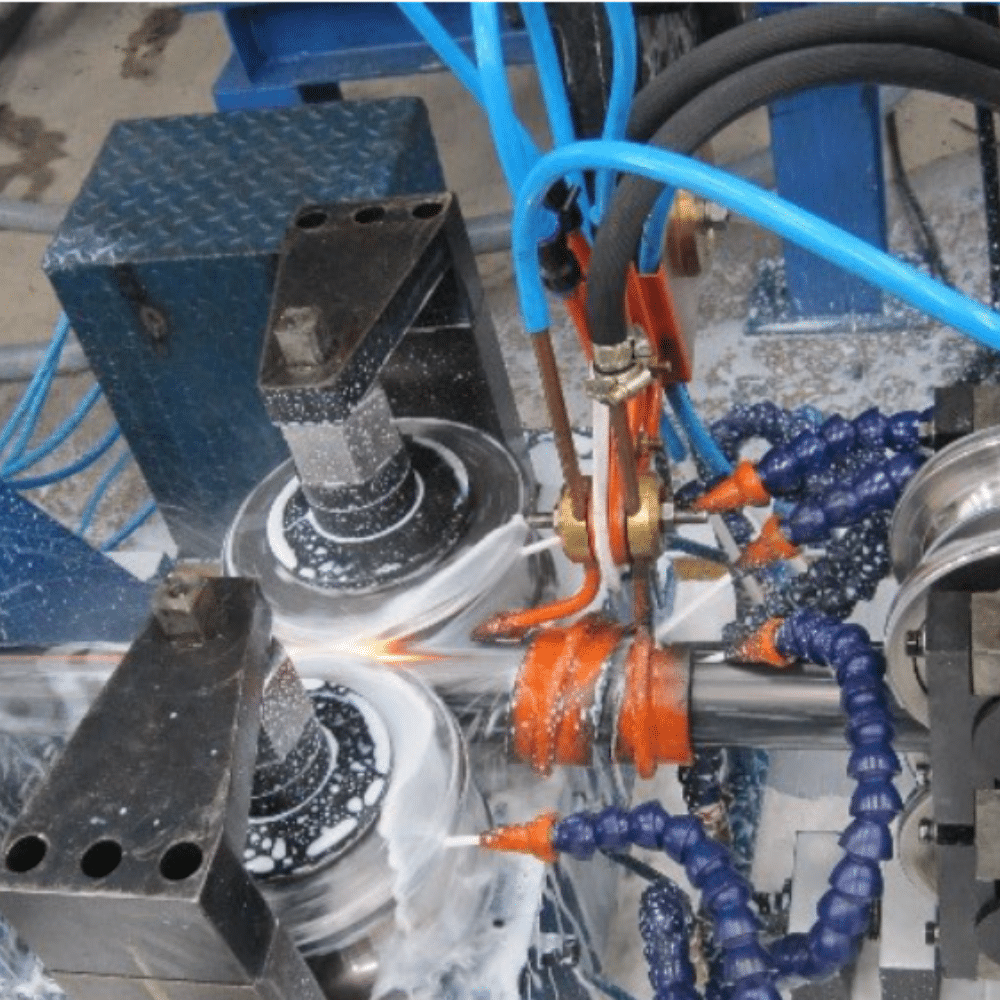
The solid-state high-frequency induction welder adopts a mature AC-DC-AC frequency conversion topology. The rectifier unit is configured with a three-phase full-bridge thyristor phase-controlled rectifier circuit, and an LC filter composed of inductors and capacitors is fitted on the DC bus to meet the operational requirements of the voltage-source inverter.
The voltage-source inverter is built with a modular parallel structure to realize expandable output power. Each inverter module comprises a single-phase MOSFET full-bridge circuit connected to a series resonant tank circuit through a high-frequency matching transformer. The matching transformer fulfills two core functions: combining output power and optimizing impedance matching, as well as providing galvanic isolation between the power supply and welding load. A dedicated high-stability overcurrent protection circuit is embedded to rapidly respond to overcurrent faults, ensuring stable and safe inverter operation.
Core Advantages :
High Temperature and High Withstand Voltage
Silicon carbide (SiC) power devices have a theoretical maximum operating temperature above 600°C, around four times that of equivalent silicon (Si) devices, with a blocking voltage capacity 10 times higher. These outstanding characteristics allow stable service under severe extreme operating environments.
Miniaturized and Lightweight Construction
Benefiting from excellent thermal conductivity and high power density, SiC components simplify the design of heat dissipation systems. This enables compact, lightweight equipment design and effectively reduces the overall machine footprint.
Low Power Loss and Superior High-Frequency Performance
SiC devices can run at operating frequencies ten times higher than traditional silicon-based devices with no drop in conversion efficiency, reducing power loss by nearly 50%. In addition, higher operating frequency reduces the physical dimensions of peripheral passive components such as inductors and transformers, lowering overall system volume and component procurement expenses.
 English
  Español
  Русский
  العربية
  Français
  Português