Introduction
In OCTG (Oil Country Tubular Goods) manufacturing, geometric precision is non-negotiable. Oil and gas casing, tubing, and drill pipes operate under extreme downhole pressure, torsion, and temperature conditions. Even minor bending deflection, residual distortion, or inconsistent straightness can lead to thread misalignment, connection failure, leakage risks, and outright product rejection during API standard inspections.
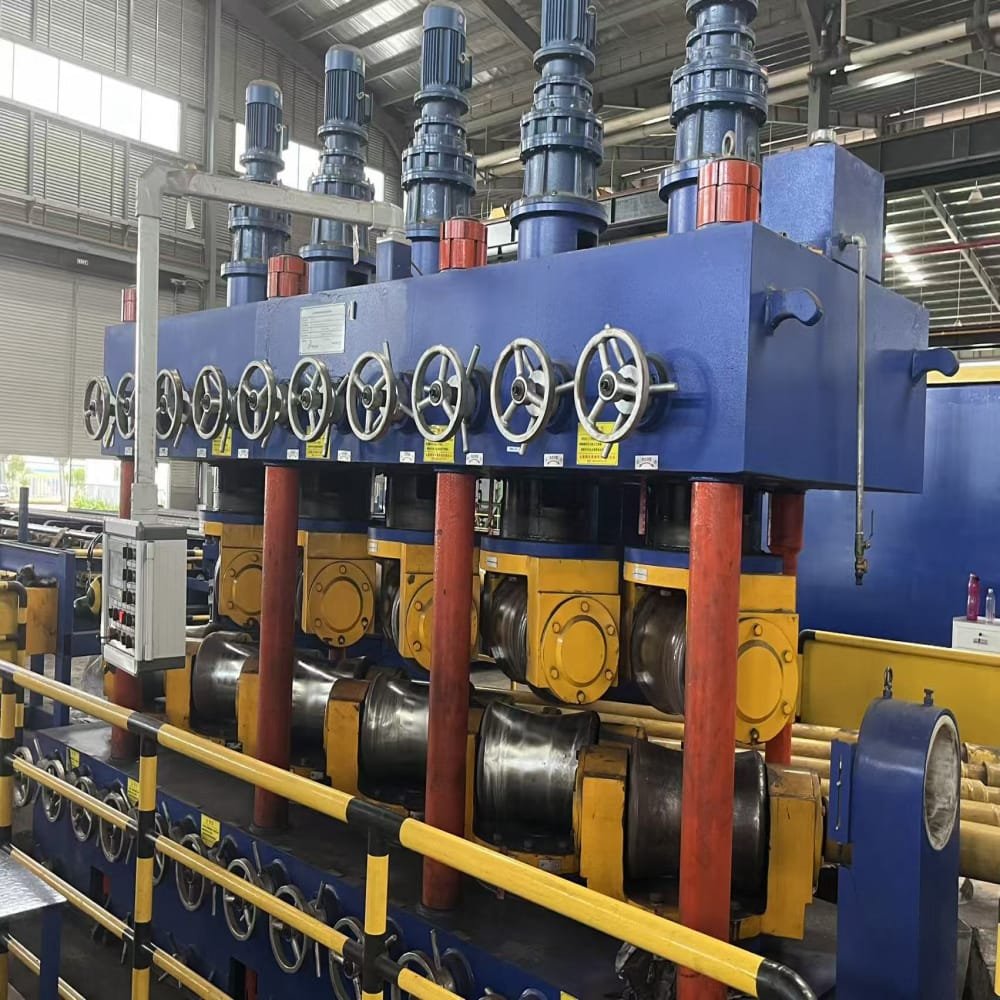
An OCTG straightening machine serves as the critical final precision-processing station in high-frequency ERW pipe production lines. It eliminates post-welding and post-sizing bending deformation, corrects residual stress, and ensures finished pipes meet strict API tolerance standards for straightness, roundness, and overall geometric consistency. For pipe mill owners, choosing the right OCTG straightening equipment directly determines product qualification rates, batch stability, and long-term production profitability.
This comprehensive guide breaks down the working principle of OCTG straightening machines, core technical advantages, key classification types, and actionable selection criteria for ERW tube line integration. It helps global manufacturers avoid equipment mismatches, quality defects, and unnecessary production downtime.
What Is an OCTG Straightening Machine?
An OCTG straightening machine is a dedicated precision correction device designed exclusively for oil and gas tubular products. Unlike ordinary civil pipe straighteners, it is engineered to handle thick-walled, high-strength steel pipes used in petroleum and natural gas exploration and transportation.
After ERW pipe forming, high-frequency welding, cooling, and sizing processes, finished OCTG pipes inevitably produce tiny bending deformation, radial runout, and residual internal stress. These defects are invisible to the naked eye but fail strict API 5CT and API 5L tolerance tests. The straightening machine applies controlled plastic deformation to eliminate irregular curvature, uniformize pipe stress distribution, and deliver pipes with consistent straightness and geometric accuracy.
Modern OCTG straightening units are fully integrated with automated ERW production lines, supporting continuous high-speed feeding, automatic parameter adjustment, and non-stop batch straightening. They perfectly match W forming, FF/FFX flexible forming, and DFT direct forming processes to deliver consistent final product quality.
Core Working Principle of OCTG Straightening Machines
The working logic of industrial OCTG straighteners follows the elastic-plastic deformation theory. It adopts multi-roller cross arrangement and gradient pressure correction to convert uneven pipe bending into uniform linear straightness, achieving one-time precision shaping through repeated cyclic deformation.
1. Pre-Straightening Material Feeding
After sizing and pre-straightening by Turks Head units, OCTG pipes are horizontally fed into the straightening machine through an automatic conveying system. The feeding system ensures stable linear delivery, avoiding secondary bending caused by uneven force during pipe entry. For high-strength OCTG pipes, synchronous speed matching between the feeding unit and straightening rollers is critical to prevent surface scratches and stress concentration.
2. Skewed Roller Bending Correction (Core Process)
The straightening machine adopts upper and lower parabolic profiling rollers arranged at a specific skew angle (typically 25° to 35° for standard OCTG models). As the pipe passes through the roller gap, the staggered roller structure applies alternating positive and negative bending forces to the pipe body. This multi-directional cyclic bending eliminates single-point bending deformation and torsional distortion thoroughly.
The roller gap is precisely adjusted to 0.8–1.0 times the pipe outer diameter. This setting ensures the pipe undergoes controllable plastic deformation beyond its elastic limit while avoiding excessive compression that causes pipe ovality or wall damage. Each contact point between the roller and pipe body achieves uniform force release, gradually correcting overall curvature errors.
3. Residual Stress Elimination & Uniformization
ERW welding and cooling processes leave concentrated residual stress at weld seams and pipe walls. During the multi-roller straightening cycle, continuous micro-deformation disperses residual stress evenly across the entire pipe body. This process effectively prevents later bending rebound and dimensional deformation during subsequent threading, heat treatment, and field service.
4. Precision Finishing & Dimensional Stabilization
After 2–3 standard straightening passes, the pipe completes elastic recovery and plastic shaping. The final calibration stage optimizes pipe straightness, roundness, and linearity, ensuring all geometric indicators meet API standard tolerance requirements. Automated detection modules monitor pipe runout in real time, realizing closed-loop adjustment of straightening parameters for consistent batch quality.
Main Types of OCTG Straightening Machines & Application Scenarios
According to roller quantity, structural layout, and working modes, mainstream OCTG straightening equipment on the market is divided into three core types, suitable for different pipe specifications, wall thicknesses, and production speed requirements.
1. Five-Roller Cross Straightening Machine (Standard Type)
This is the most widely used model in conventional OCTG ERW lines. Featuring a compact five-roller cross layout, it balances straightening accuracy and production efficiency. It is ideal for medium-specification, medium-wall-thickness oil casing and tubing. With simple structure, low maintenance cost, and stable operation, it adapts to continuous mass production and perfectly matches W forming process production lines.
2. Seven-Roller High-Precision Straightening Machine
Designed for high-standard thin-wall and high-precision OCTG pipes, the seven-roller structure adds auxiliary correction rollers based on the five-roller model. It achieves more delicate cyclic deformation control, effectively eliminating micro-bending and tiny runout defects. This model is widely used for premium-grade OCTG products requiring ultra-strict straightness tolerance, supporting FF/FFX flexible forming high-precision production lines.
3. Hydraulic Quick-Change Straightening Machine
Equipped with hydraulic automatic lifting and universal shaft automatic engagement/displacement systems, this model integrates quick-change structural design. It supports offline roller preparation and adjustment without production shutdown, greatly reducing product switchover downtime. It is the best choice for multi-specification, flexible OCTG production lines compatible with DFT direct forming technology, significantly improving overall line productivity.
Key Advantages of Professional OCTG Straightening Equipment
Compared with ordinary pipe straighteners, dedicated OCTG straightening machines have unique technical advantages tailored to oil country tubular goods production characteristics:
1. API Standard Compliance & Ultra-High Straightness Accuracy
Professional OCTG straightening equipment achieves straightness accuracy up to ±0.2mm/m, fully meeting API 5CT and API 5L industrial standards. It eliminates unqualified products caused by bending deformation, ensuring pipes pass strict downhole application quality inspections.
2. No Surface Damage & Stable Wall Uniformity
Adopting customized parabolic profiling rollers and constant-pressure control technology, the equipment avoids pipe surface indentation, scratches, and ovality deformation during straightening. It protects weld seam integrity and wall thickness uniformity, maintaining the mechanical properties of high-strength steel pipes.
3. Effective Residual Stress Relief
Targeted straightening process parameters eliminate welding and sizing residual stress, preventing pipe bending rebound and thread deformation in subsequent processing. It improves product fatigue resistance and service life in harsh downhole environments.
4. High Compatibility & Flexible Production
It is highly compatible with mainstream ERW line processes including W forming, FF/FFX flexible forming, and DFT direct forming. It supports quick switching of round, square, and rectangular OCTG pipe specifications, adapting to diversified production needs of modern pipe mills.
5. Low Operation Cost & High Productivity
Automated parameter adjustment and quick-change structure reduce manual intervention, lowering labor costs and human error. Stable equipment operation reduces wear and failure rates, extending service life and improving continuous production efficiency.
Complete OCTG Straightening Machine Selection Guide (Key Criteria)
Selecting a mismatched straightening machine will lead to unstable product quality, frequent equipment failure, and increased production costs. The following core criteria help you select the most suitable equipment for your OCTG production line.
1. Match Pipe Specification Range
Confirm the outer diameter, wall thickness, and steel grade of produced OCTG pipes first. Thin-wall high-precision casing requires seven-roller high-precision straighteners; medium and thick-wall conventional tubing can adopt cost-effective five-roller models; multi-specification mixed production prioritizes hydraulic quick-change straightening equipment to improve switching efficiency.
2. Adapt to Production Line Speed
High-speed ERW production lines supporting FF/FFX and DFT forming must be matched with high-speed synchronous straightening machines to avoid process bottlenecks. Low-speed conventional lines can choose standard models to control equipment investment costs while ensuring matching production rhythm.
3. Clarify Quality Tolerance Requirements
For export-grade high-standard OCTG products with strict API tolerance requirements, select high-precision seven-roller straightening equipment to guarantee ultra-low straightness error and zero rebound. For ordinary industrial-grade products, standard five-roller models can meet basic qualification needs.
4. Prioritize Line Compatibility
Ensure the straightening machine’s structural size, feeding speed, and control system are compatible with the front-end forming, sizing, and cooling processes. Integrated automated control models with recipe databases and one-click parameter adjustment are more suitable for modern intelligent OCTG production lines.
5. Consider Maintenance & Operating Costs
For long-term batch production, prioritize equipment with simple maintenance, low roller wear, and hydraulic quick-change functions. It can effectively reduce later replacement costs, labor investment, and production downtime, maximizing long-term economic benefits.
Common Production Problems Solved by Professional OCTG Straighteners
Many pipe mills face frequent quality complaints and low qualification rates due to backward straightening equipment. Professional OCTG straightening machines perfectly solve the following industry pain points:
-
Pipe bending rebound: Thoroughly eliminate residual stress to avoid post-processing deformation
-
Uneven straightness and dimensional out-of-tolerance: Multi-point cyclic correction ensures overall geometric consistency
-
Low production efficiency caused by frequent specification switching: Quick-change structure shortens downtime and improves line utilization
-
Surface scratch and weld seam damage: Profiled roller design protects pipe surface integrity
-
Unstable batch quality: Automated closed-loop control realizes consistent straightening effect for all products
Conclusion
As the final precision guarantee link of OCTG ERW production lines, the straightening machine directly determines product quality grade and market competitiveness. Understanding its elastic-plastic straightening principle, equipment classification, and scientific selection rules helps manufacturers match the most suitable equipment according to production needs, effectively improving product qualification rate, reducing operating costs, and realizing stable and efficient batch production of high-standard oil casing and tubing.
Whether you are upgrading old production lines or building new intelligent OCTG pipe mills, choosing a high-precision, high-compatibility, low-maintenance straightening machine is the key to long-term stable development of your pipe manufacturing business.
FAQs
Q1: What is the standard straightness tolerance for OCTG pipes?
According to API 5CT standards, premium OCTG pipes require straightness tolerance within ±0.2mm per meter, which can only be stably achieved by professional multi-roller straightening equipment.
Q2: Can ordinary pipe straighteners replace dedicated OCTG straightening machines?
No. Ordinary straighteners cannot eliminate residual stress of high-strength steel pipes and fail to meet API strict tolerance standards, easily causing product rejection in oil and gas engineering applications.
Q3: How to improve the service life of OCTG straightening machine rollers?
Regularly calibrate roller gaps and angles, adopt high-hardness wear-resistant rollers, and match straightening parameters according to pipe specifications to reduce friction and extrusion wear.
 English
  Español
  Русский
  العربية
  Français
  Português