نظرة عامة
API 5DP is the authoritative global specification for seamless steel drill pipes used in onshore and offshore oil and gas drilling, well exploration, and directional drilling projects. As core components of drilling string systems, API 5DP drill pipes require exceptional tensile strength, torsional resistance, fatigue durability, and structural stability to withstand extreme underground conditions including high pressure, high torque, abrasive wear, and complex geological impacts. Professional API 5DP-compliant drill pipe production lines adopt standardized integrated manufacturing processes from raw material inspection to finished product delivery, strictly following API 5DP technical specifications, quality testing criteria, and industry manufacturing norms. This article comprehensively introduces the complete production flow, core equipment configuration, and working technical principles of standard API 5DP drill pipe production lines, helping global EPC contractors, oilfield service companies, and procurement specialists fully understand the technical advantages and quality control logic of standardized drill pipe manufacturing.
Core Production Orientation & API 5DP Compliance Standards
The entire production line is designed and operated in full accordance with API Specification 5DP, covering all technical requirements for drill pipe material grades, dimensional tolerance, mechanical properties, end upsetting structure, welding performance, heat treatment standards, and non-destructive testing (NDT) indicators. The production line supports the manufacturing of mainstream API 5DP drill pipe grades including E75, X95, G105, and S135, covering common specifications of external upset (EU), internal upset (IU), and internal-external upset (IEU) drill pipes for oil and gas drilling.
Different from ordinary seamless steel pipe production lines, the API 5DP drill pipe production line focuses on strengthening the structural performance of pipe ends and the overall fatigue resistance of the pipe body. All production links strictly control dimensional accuracy, metallographic structure stability, and mechanical parameter consistency to eliminate hidden dangers such as thread failure, weld cracking, pipe body deformation, and fatigue fracture during high-load drilling operations. Every batch of finished drill pipes can provide complete API 5DP certified test reports and material traceability documents to meet the quality audit requirements of international oil and gas EPC projects.
Complete Production Process Flow of API 5DP Drill Pipe
The standardized API 5DP drill pipe manufacturing process consists of 12 core links, forming a closed-loop production system of “raw material screening → pipe blank forming → end upsetting → precision friction welding → integral heat treatment → mechanical finishing → thread machining → multi-dimensional non-destructive testing → pressure resistance verification → surface anti-corrosion treatment → finished product sorting and packaging”. Each process is equipped with special professional equipment and independent quality inspection procedures to ensure full compliance with API 5DP standards.
Raw Material Selection & Pre-Production Inspection
High-quality alloy steel billets (AISI 4130/4140 series) are selected as the base material for API 5DP drill pipes, which feature high toughness, high strength, and excellent weldability, fully adapting to the performance requirements of oilfield drilling environments. Before production, all steel billets undergo strict chemical composition analysis and mechanical property sampling tests to ensure carbon, manganese, chromium, molybdenum and other alloy element ratios meet API 5DP material standards, avoiding material defects that affect drilling safety.
Meanwhile, the production line adopts full material traceability management, recording batch numbers, heat treatment numbers, and inspection data of each steel billet to realize full-cycle traceability from raw materials to finished products, which is a mandatory requirement of API 5DP standard quality management.
Pipe Blank Piercing & Seamless Forming
Qualified steel billets are sent to the rotary heating furnace for uniform high-temperature heating, with the heating temperature precisely controlled between 1200℃ and 1250℃ to ensure uniform metal plasticity. The heated steel billets enter the mandrel piercing unit for one-time seamless piercing forming, eliminating longitudinal weld structures that easily cause stress concentration. After piercing, the pipe blanks are rolled and sized by a continuous rolling mill to complete the preliminary forming of drill pipe bodies with uniform wall thickness and smooth inner and outer surfaces.
The core technical principle of this link is thermoplastic metal forming, which uses high-temperature heating to reduce metal yield strength and uses mechanical rolling force to refine the internal grain structure of the steel pipe, improving the compactness and overall strength of the pipe body and laying a foundation for the subsequent high-performance processing of API 5DP drill pipes.
Pipe End Upsetting Forging Processing
Pipe end upsetting is the key process to improve the connection strength of drill pipes and is a core mandatory process specified by API 5DP standards. Since drill pipe joints bear the maximum torque and tensile force during drilling, local wall thickness thickening must be carried out on both ends of the seamless pipe blank to form standard EU, IU or IEU upset structures.
The production line is equipped with a special hydraulic upsetting forging press. After secondary local heating of the pipe ends, high-precision closed-die forging technology is adopted to displace metal materials evenly, forming a standard transition slope of 1:4.5 to 1:5 specified by API 5DP. This gradient transition structure effectively avoids stress concentration at the joint, solves the problem of easy fracture of traditional straight-thick pipe ends, and significantly improves the fatigue resistance of drill pipe joints. After upsetting, the pipe ends are trimmed and sized to ensure dimensional tolerance strictly meets API 5DP precision requirements.
Precision Friction Welding of Tool Joints
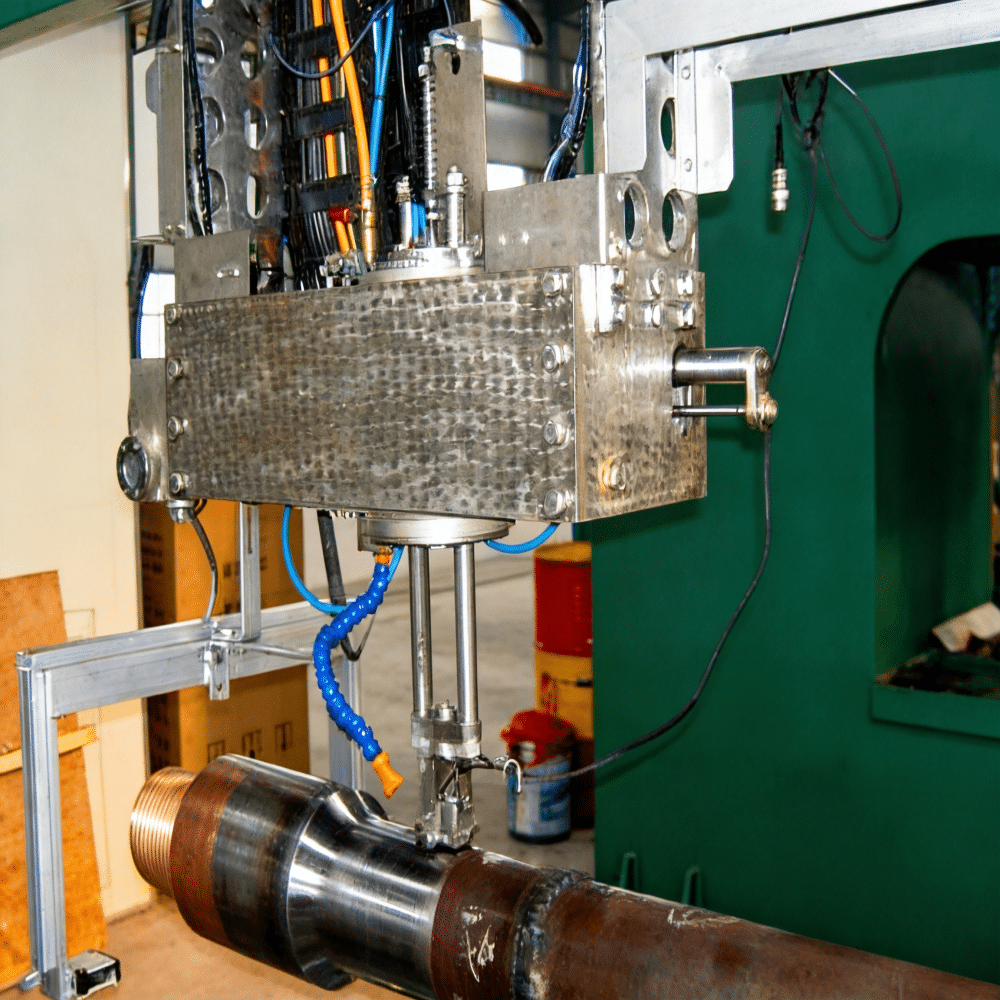
Tool joint welding is the most critical link affecting the service life of drill pipes, and the production line adopts advanced inertia friction welding technology exclusively for API 5DP drill pipes, replacing traditional arc welding processes. The core equipment is a high-precision rotary friction welding machine, with the working principle of using high-speed relative rotation and axial pressure between the drill pipe body and tool joint to generate friction heat, heating the contact interface to a plastic state below the metal melting point, and completing metallurgical bonding through precise top forging pressure.
During operation, the equipment stably controls the rotating speed at 3000RPM and axial forging force at 25 tons, generating stable friction heat of about 1200℃ to realize molecular-level atomic diffusion bonding. The friction welding joint retains more than 98% of the base metal strength, with no welding pores, cracks, inclusions and other defects, completely meeting the API 5DP high-standard welding quality requirements. Compared with traditional welding, friction welding has higher joint toughness, stronger torsional resistance, and more stable performance in high-load drilling operations.
Integral Quenching & Tempering Heat Treatment
To meet the graded mechanical performance requirements of API 5DP E75/X95/G105/S135 drill pipes, the production line is equipped with an integral automatic heat treatment production line, adopting integral quenching and high-temperature tempering process for overall performance optimization of drill pipes. After friction welding and flash removal, the drill pipes are sent to the heat treatment furnace for overall heating, rapid water quenching and constant-temperature tempering treatment.
The technical principle is to refine the internal martensitic and sorbitic grain structure of the steel pipe through temperature cycle control, eliminate welding stress and forging residual stress, and significantly improve the tensile strength, yield strength and impact toughness of the drill pipe. After heat treatment, the hardness of the drill pipe is stably controlled between HRC22-HRC26, and all mechanical performance indicators fully comply with API 5DP grade standards, ensuring the drill pipe can withstand long-term high-torque, high-stress underground working conditions.
Precision Machining & Standard Thread Processing
Heat-treated drill pipes enter the CNC finishing workshop for outer circle finishing, end face leveling and API standard thread machining. The production line is equipped with special drill pipe thread CNC lathes, which precisely process NC threads and VAM special threads specified by API 5DP. The equipment adopts full-program digital control to control thread pitch, tooth height, taper and sealing surface accuracy in real time, ensuring the tightness and interchangeability of drill pipe connections.
All threads are processed with high-precision tool setting and multiple fine turning processes, with dimensional tolerance controlled within ±0.01mm. After machining, thread surface polishing and burr removal are carried out to avoid thread wear and loosening during repeated assembly and disassembly, ensuring the connection stability of the drilling string system.
Multi-Dimensional Non-Destructive Testing (NDT)
In accordance with API 5DP mandatory inspection standards, the production line is equipped with a full-coverage non-destructive testing system to conduct comprehensive defect detection on finished drill pipes, covering pipe bodies, upset sections and friction welding joints. The core testing equipment includes ultrasonic testing (UT) instruments and magnetic particle inspection (MPI) equipment.
Ultrasonic testing is used to detect internal defects such as wall thickness deviation, layered inclusions and longitudinal cracks in the pipe body, eliminating unqualified products with wall thickness error exceeding ±5%. Magnetic particle inspection is responsible for scanning micro-cracks and surface defects on the pipe end and welding surface, with the detection sensitivity reaching level 2 standard specified by API. All testing data is automatically recorded and archived to form electronic inspection reports, realizing zero-defect delivery of products.
Hydrostatic Pressure Test & Performance Verification
Each API 5DP drill pipe will undergo a full-length hydrostatic pressure test according to standard requirements. The high-pressure hydraulic test equipment injects high-pressure water into the sealed drill pipe, maintains the standard pressure value for a fixed time, and monitors pressure changes in real time. This test verifies the pressure resistance and overall structural tightness of the drill pipe, ensuring no leakage or deformation under the working pressure specified by API 5DP and eliminating potential safety hazards in high-pressure drilling operations.
Surface Anti-Corrosion Treatment & Finished Product Packaging
Qualified drill pipes are subjected to professional surface anti-corrosion treatment, including rust removal, phosphating and oil sealing, to prevent oxidation and corrosion during transportation and storage. The pipe ends are equipped with special thread protective caps to avoid thread damage. Finally, the drill pipes are bundled and packaged in strict accordance with export standards, attached with API 5DP certification labels, batch inspection reports and material traceability documents, meeting the delivery requirements of international oilfield EPC projects.
Core Equipment Configuration & Technical Advantages of Production Line
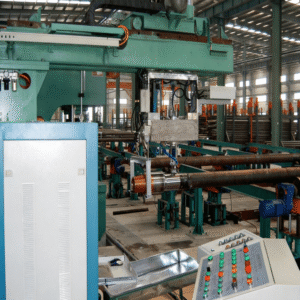
The standardized API 5DP drill pipe production line adopts full-automatic integrated equipment configuration, covering heating, forming, forging, welding, heat treatment, machining and testing links, with high production precision, stable performance and strong standard compliance. The core equipment and technical advantages are summarized as follows:
First, the intelligent rotary heating furnace and precise temperature control system realize uniform heating of steel billets and pipe ends, effectively avoiding performance differences caused by uneven heating and ensuring consistent metallographic structure of each drill pipe. Second, the high-precision hydraulic upsetting press realizes one-time forming of standard upset structures, with smooth transition sections and no stress concentration, fully complying with API 5DP structural design specifications.
Third, the imported inertia friction welding machine is the core equipment to ensure joint quality. Its precise rotating speed and pressure control system make the welding joint have high strength and high toughness, far exceeding the quality level of traditional welding processes. Fourth, the automatic integral heat treatment production line realizes accurate temperature regulation and uniform heating, ensuring stable mechanical performance of drill pipes of all grades.
In addition, the full-coverage NDT testing system and digital data recording function realize full-process quality monitoring and traceability, which is the core guarantee for products to pass API 5DP standard certification. The whole production line supports customized production of multiple specifications and multiple grades of drill pipes, meeting the diversified procurement needs of global oil and gas drilling projects.
API 5DP Standard Production Core Value & Application Scenarios
Drill pipes produced by standardized API 5DP production lines have outstanding performance advantages such as high strength, high fatigue resistance, stable welding performance and zero structural defects, and are widely applicable to onshore conventional oil and gas drilling, offshore deepwater drilling, directional drilling, ultra-deep well drilling and complex geological condition drilling projects. Strictly following API 5DP standard production effectively reduces the failure rate of drill pipes in high-load working environments, reduces project maintenance costs, and improves the overall safety and efficiency of drilling operations.
For global EPC engineering companies, oilfield service providers and drilling equipment procurement specialists, API 5DP certified drill pipes with standardized production processes have higher market credibility and project applicability, which can perfectly meet the strict quality assessment requirements of international oil and gas projects.
الخلاصة
The API 5DP drill pipe production line realizes standardized, refined and intelligent manufacturing of drill pipes through scientific process design, professional equipment configuration and strict standard control. From raw material screening to finished product delivery, every production link strictly abides by API 5DP specifications, ensuring that all dimensional accuracy, mechanical properties, welding quality and safety indicators of products meet international industry standards. With reliable product performance and complete quality certification documents, our API 5DP drill pipes have become the preferred choice for global oil and gas drilling projects, providing high-quality and high-stability drilling string solutions for international EPC contractors and oilfield enterprises.
 English
  Español
  Русский
  العربية
  Français
  Português