Overview
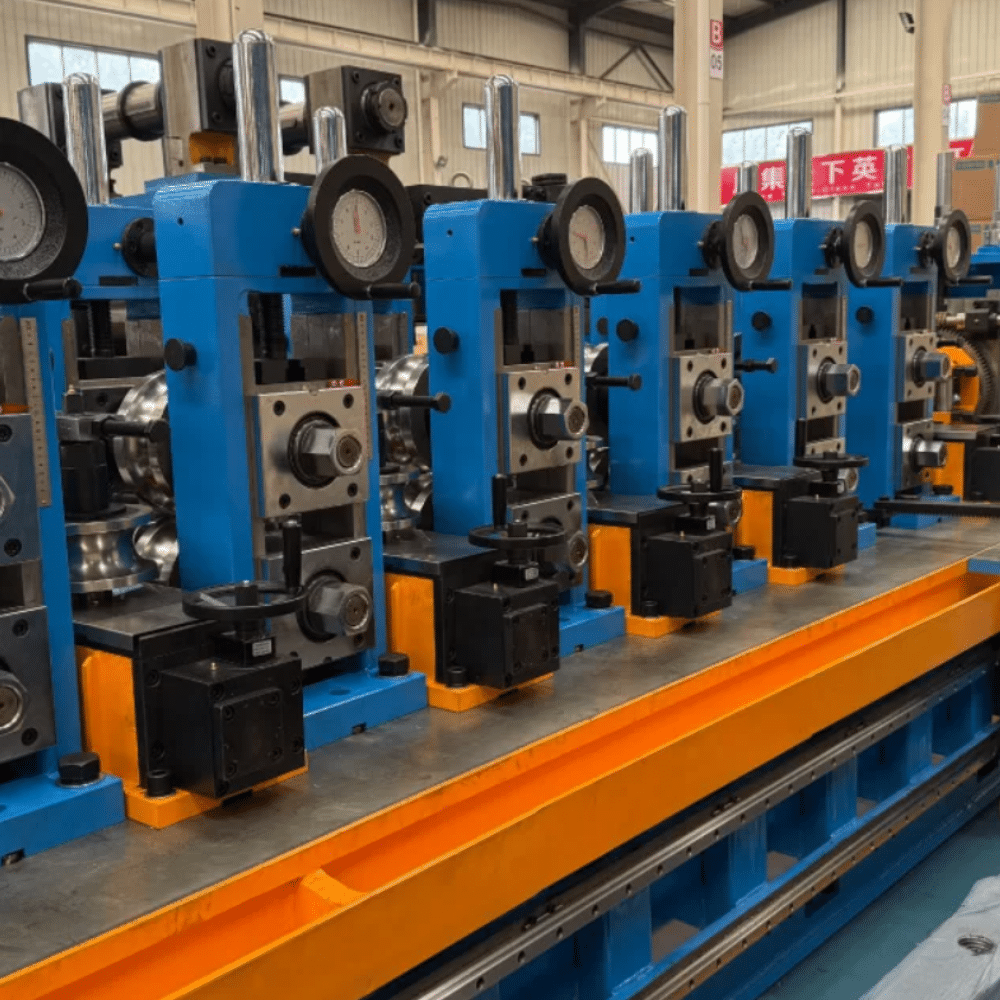
The Electric Resistance Welding (ERW) tube mill line is the most widely used high-efficiency pipe production equipment for manufacturing carbon steel, alloy steel, and galvanized steel pipes. As the core functional section of the entire ERW pipe production system, the forming and sizing unit directly determines the dimensional accuracy, surface quality, structural stability, and yield rate of finished steel pipes. It undertakes the whole process of gradual cold bending deformation from flat steel strip to closed tubular blank and final precision shaping, serving as the decisive module that distinguishes high-quality ERW tube mills from ordinary equipment.
For global pipe manufacturers, understanding the structure, classification, and application scenarios of the forming and sizing unit is critical for equipment selection, production process optimization, and product quality upgrading. This article comprehensively analyzes the core composition, mainstream classification, technical characteristics, and industrial applications of ERW tube mill forming and sizing units, providing professional technical reference for overseas buyers, factory technicians, and engineering purchasers.
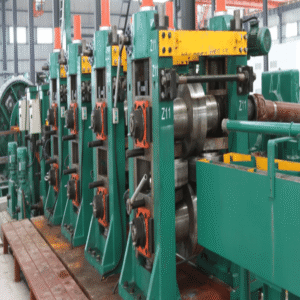
1. Core Composition of ERW Forming & Sizing Unit
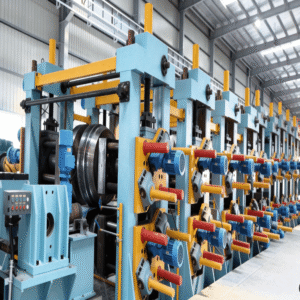
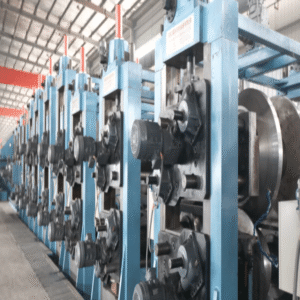
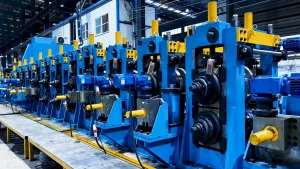
The forming and sizing unit is a continuous roll-forming system composed of multiple precision roll stands, auxiliary adjustment mechanisms, and detection components. It operates based on the cold plastic deformation principle, realizing stepwise and uniform shaping of steel strips to avoid local stress concentration and pipe deformation. The entire unit is scientifically divided into three core functional sections: pre-forming section, fine forming section, and sizing straightening section, with each section cooperating closely to complete high-precision pipe shaping.
1.1 Pre-forming Section
The pre-forming section is the initial deformation module of the entire unit, mainly composed of horizontal roll stands and vertical auxiliary roll stands, usually equipped with 4-6 groups of roll systems. Its core function is to bend the flat steel strip from both sides to the middle gradually, completing preliminary arc shaping and laying a foundation for subsequent closed forming.
This section adopts a symmetrical deformation design to ensure uniform stress on both sides of the steel strip. It effectively eliminates the defects of edge warping and uneven bending in the initial forming stage. Equipped with manual or electric fine-tuning devices, the pre-forming rolls can adjust the bending radian according to different strip thicknesses and pipe diameters, adapting to the production of thin-walled and medium-thick-walled steel pipes. High-precision bearing seats and wear-resistant alloy roll surfaces ensure long-term stable operation and reduce production maintenance costs.
1.2 Fine Forming Section
As the core working area of tube blank forming, the fine forming section consists of 4-6 sets of high-precision horizontal and vertical roll combinations, which further compress and shape the pre-formed semi-circular strip. It accurately controls the strip butt gap to ensure uniform and seamless closing of the tube blank, providing optimal welding conditions for the subsequent high-frequency welding process.
Different from the pre-forming section, the fine forming section features micro-gradient deformation. Each roll stand completes a fixed small-range bending deformation, avoiding one-time forced shaping that causes material fatigue and surface scratches. The roll gap and center height of each stand support precise CNC adjustment, which can accurately control the roundness and straightness of the tube blank. This module is the key to solving common quality problems such as pipe ovality and welding deviation in ERW pipe production.
1.3 Sizing & Straightening Section
The sizing and straightening section is the final precision shaping module of the forming and sizing unit, mainly composed of sizing roll stands and Turkey head straightening mechanisms. After high-frequency welding and burr removal, the welded tubular blank enters this section for final dimensional calibration and shape correction.
The sizing rolls accurately correct the outer diameter tolerance of the steel pipe, eliminating tiny deformation and diameter deviation generated during welding and forming, ensuring the finished pipe meets international standard dimensional accuracy. The multi-group Turkey head straightening device effectively corrects pipe bending and torsion deformation, optimizing the straightness and roundness of the finished pipe. For multi-specification production lines, this section supports rapid roll replacement and parameter switching, realizing flexible production of pipes with different diameters and wall thicknesses.
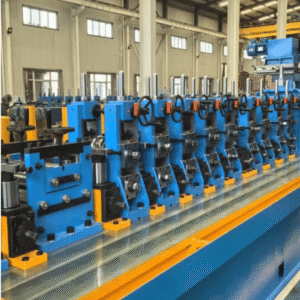
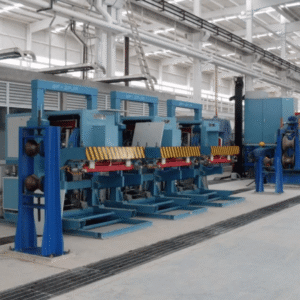
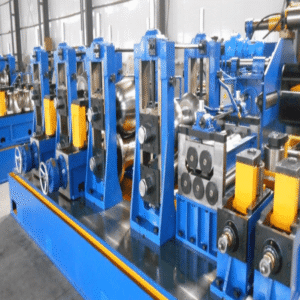
2. Main Classification of ERW Forming & Sizing Unit
According to different forming processes, structural configurations, and production capabilities, ERW tube mill forming and sizing units are mainly classified into three mainstream types: conventional W-type forming unit, FF flexible forming unit, and FFX high-precision flexible forming unit. Each type has unique technical advantages and applicable production scenarios, covering low, medium, and high-end ERW pipe production markets.
2.1 Conventional W-type Forming & Sizing Unit
The W-type forming unit is the most traditional and cost-effective forming system, widely used in standard ordinary ERW tube mill lines. It adopts a classic multi-pass W-shaped bending process, with a simple and stable mechanical structure and low equipment investment and maintenance costs.
This unit is usually equipped with 8-12 fixed roll stands, with fixed roll pass parameters and single product adaptation. It is mainly suitable for producing conventional round steel pipes with outer diameters of 25mm-200mm and wall thicknesses of 1.5mm-6mm. With stable operation and low failure rate, it fully meets the production needs of standard pipes for construction, common machinery, and ordinary pipelines. However, its flexibility is limited, requiring overall roll replacement when switching pipe specifications, resulting in relatively long specification conversion time and low production efficiency for multi-variety and small-batch orders.
2.2 FF (Flexible Forming) Unit
The FF flexible forming unit is an upgraded optimized version based on the conventional W-type process, breaking through the limitation of fixed pass forming. It adopts an adjustable flexible roll structure, with independent electric adjustment devices for each roll stand, realizing stepless fine-tuning of roll gap and forming radian.
Compared with traditional W-type units, the FF forming system has stronger production flexibility. It can quickly switch pipe specifications within a certain diameter range without replacing rolls, greatly shortening production preparation time and improving production efficiency. The gradient deformation process is more reasonable, which effectively reduces forming stress, improves pipe surface smoothness, and reduces defective rates such as cracks and deformation. It is widely applicable to medium-precision pipe production, including galvanized pipes, furniture pipes, and general industrial pipes, with a production speed up to 60m/min.
2.3 FFX (Flexible Forming Excellent) High-precision Unit
The FFX high-precision flexible forming unit is the most advanced forming and sizing technology in the current ERW tube mill industry, specially developed for high-precision, high-strength, and thick-walled steel pipe production. It adopts an optimized full-gradient flexible forming process and a fully CNC intelligent adjustment system.
This unit realizes full-process precise control from strip feeding to pipe sizing, with ultra-low forming stress and extremely high dimensional accuracy. The finished pipe has small ovality deviation, excellent straightness, and uniform wall thickness, fully meeting strict international standards. It supports the production of large-diameter and thick-walled steel pipes with outer diameters up to 660mm and wall thicknesses up to 20mm, covering high-strength carbon steel and low-alloy steel pipe production. Equipped with an intelligent monitoring system, it can real-timely detect forming deviation and automatically correct parameters, suitable for high-end precision pipe production in petroleum, chemical, and automotive industries.
2.4 DFT (Direct Forming Technology) Efficient Forming Unit
The DFT efficient direct forming unit is a mature and high-efficiency forming technology in the modern ERW tube mill industry, specially developed for standardized, high-stability, and mass production of medium and thin-walled steel pipes. It adopts a simplified one-step direct forming process and a high-precision fixed-point roller positioning system.
This unit realizes one-time rapid shaping from flat strip to tubular blank without redundant intermediate bending passes, with low forming resistance and stable overall structural consistency. The finished pipe features uniform wall thickness, controllable ovality error, and low residual stress, fully satisfying mainstream industrial manufacturing standards. It supports conventional steel pipe production with outer diameters up to 426mm and wall thicknesses up to 16mm, covering ordinary carbon steel and common low-alloy steel materials. Equipped with real-time forming tracking and parameter fine-tuning functions, it effectively reduces production costs and tool wear, suitable for mass pipe production in construction, machinery manufacturing, and general engineering industries.
3. Industrial Applications of Forming & Sizing Unit
As the core module of ERW tube mills, forming and sizing units support the production of various specifications of round, square, and rectangular steel pipes, covering almost all fields of steel pipe application. Different types of units match differentiated industrial scenarios, providing customized production solutions for global manufacturing enterprises.
3.1 Construction & Civil Engineering Industry
Conventional W-type and FF flexible forming units are widely used in the production of construction steel pipes, including scaffolding pipes, structural steel pipes, and building drainage pipes. The stable forming performance ensures the structural stability and pressure resistance of construction pipes, meeting the basic load-bearing and safety requirements of construction projects. The low-cost and high-efficiency production characteristics are very suitable for large-scale and standardized construction pipe orders, which is the mainstream equipment configuration of most construction pipe manufacturers.
3.2 Machinery & Furniture Manufacturing Industry
FF flexible forming units are the preferred equipment for furniture pipes and mechanical structural pipes. The flexible forming process ensures smooth pipe surfaces without scratches, uniform specifications, and good bending and welding performance. It can produce special-shaped pipes such as square pipes and rectangular pipes needed for furniture brackets, mechanical frames, and automobile accessories. The flexible specification switching capability meets the multi-variety production needs of the furniture and machinery industry, effectively reducing enterprise production costs.
3.3 Petroleum, Chemical & Pipeline Engineering
High-end FFX high-precision forming and sizing units are mainly used for producing high-pressure and corrosion-resistant steel pipes for petroleum and chemical pipelines. The high-precision sizing function ensures that the pipe diameter tolerance and roundness fully meet pipeline engineering standards, avoiding pipeline leakage and pressure instability caused by dimensional deviation. The low-stress forming process improves the structural strength and fatigue resistance of thick-walled pipes, adapting to harsh working environments such as high pressure and strong corrosion in oil and gas transportation and chemical fluid transmission.
3.4 Automotive & Precision Manufacturing Industry
With the rapid development of the automotive industry, the demand for high-precision lightweight steel pipes is increasing. FFX high-precision forming units can produce ultra-precision thin-walled and high-strength alloy steel pipes, which are widely used in automobile exhaust pipes, chassis structural pipes, and mechanical precision pipelines. The intelligent precise adjustment function ensures the consistency of batch product specifications, meeting the strict precision requirements of the automotive industry for supporting parts.
4. Technical Advantages & Selection Guidelines
The performance of the forming and sizing unit directly affects the overall production capacity and product competitiveness of the ERW tube mill line. Choosing a suitable forming and sizing unit can effectively improve production efficiency, reduce defective rates, and expand product application scope. For small and medium-sized pipe manufacturers with conventional production needs, W-type and FF flexible units can realize cost-effective standardized production. For enterprises focusing on high-end precision pipes and large-diameter thick-walled pipes, FFX high-precision units are the best choice to enhance market competitiveness.
Modern forming and sizing units are gradually developing towards intelligence, high precision, and high flexibility. Equipped with CNC automatic adjustment systems, real-time detection devices, and intelligent fault diagnosis functions, they realize unmanned and refined production, which is the inevitable development trend of the global ERW pipe manufacturing industry.
5. Conclusion
The forming and sizing unit is the core soul of the ERW tube mill line, with its structural design, process type, and precision level determining the quality grade and application scope of finished steel pipes. From traditional W-type fixed forming to modern FF flexible forming and FFX high-precision intelligent forming, the continuous upgrading of forming and sizing technology promotes the iterative progress of the global ERW pipe manufacturing industry.
Different types of forming and sizing units cover the production needs of ordinary construction pipes, industrial structural pipes, and high-end precision pipeline pipes, serving multiple core industries such as construction, machinery, petrochemical, and automobile. For global buyers and manufacturers, mastering the classification and application characteristics of forming and sizing units is crucial for equipment procurement, production optimization, and market expansion.
 English
  Español
  Русский
  العربية
  Français
  Português