
Overview
In the oil and gas industry, OCTG (Oil Country Tubular Goods) pipes including casing, tubing, and drill pipes require strict end finishing to meet API standard specifications. The OCTG end facing & chamfering machine serves as the core equipment of the OCTG production line, dedicated to processing flat end faces and precise inner and outer chamfers for steel pipe ends. High-precision end finishing eliminates burrs, corrects pipe end squareness errors, and provides standard lead-in angles for pipe threading, coupling assembly, and on-site welding. This blog comprehensively introduces the working principle, standard operation process, mainstream machine types, and selection guidelines of OCTG pipe end finishing machine, helping global purchasers choose the most suitable equipment for their production lines.
1. What Is an OCTG End Facing & Chamfering Machine?
An OCTG end facing and chamfering machine is a specialized industrial CNC processing device designed for high-precision end finishing of seamless steel pipes and welded OCTG pipes. Different from ordinary pipe chamfering equipment, it is fully optimized for the high hardness, large diameter, and strict tolerance requirements of oil and gas pipes.
The machine integrates dual functions of end facing and chamfering in one single process, capable of completing flat end surface trimming, outer wall chamfering, and inner wall deburring chamfering simultaneously. All processing dimensions strictly comply with API 5CT, API 5B and international oil pipe manufacturing standards. It is an indispensable key device in standardized OCTG production line, widely used in petroleum pipe manufacturing, steel pipe deep processing, and energy equipment supporting industries worldwide.
Qualified pipe end finishing can effectively avoid thread damage, assembly gaps, and welding defects, greatly improving the sealing performance and structural stability of OCTG pipes in downhole and pipeline applications.


2. Working Principle of OCTG End Facing & Chamfering Machine
The working principle of the CNC pipe chamfering equipment is based on precision mechanical clamping and high-speed rotary cutting, realizing one-time forming of pipe end flatness and chamfering through coordinated operation of mechanical structure, spindle system, and CNC control system. Its core working logic is stable and efficient, suitable for long-term continuous industrial production.
First, the equipment adopts a precision self-centering clamping system. After the OCTG pipe is transported to the processing station, the hydraulic or pneumatic clamping mechanism automatically positions and locks the pipe body, ensuring that the pipe centerline is completely consistent with the spindle rotation centerline. This design completely solves the processing deviation caused by pipe offset and vibration, and guarantees the squareness and uniformity of the pipe end face.
Second, the high-power main spindle drives the custom cutting head with hard alloy blades to rotate at a constant high speed. The cutting head is equipped with independent facing blades and inner/outer chamfering blades. Under the precise feed control of the CNC system, the blades perform axial and radial micro-feeding to cut the pipe end. The facing blade trims the uneven pipe end into a flat and vertical surface perpendicular to the pipe axis, while the inner and outer chamfering blades cut standard bevel angles on the pipe end edges to remove burrs and sharp edges.
All core parameters including chamfer angle, chamfer depth, facing feed speed, and spindle rotation speed are digitally adjustable. Operators can preset multiple sets of processing programs according to different OCTG pipe specifications (casing, tubing, drill pipe) and quickly switch production. The whole processing process realizes mechanical automation, avoiding manual operation errors and ensuring consistent processing accuracy of each pipe end.
In addition, the equipment is equipped with an automatic chip removal system and cooling system. The cooling liquid cools the cutting blades and pipe ends in real time to prevent high-temperature deformation affecting precision, while the chip removal device automatically collects metal scraps to keep the processing station clean and ensure stable long-term operation of the oil casing pipe end facing machine.

3. Standard Operation Flow of OCTG Pipe End Finishing
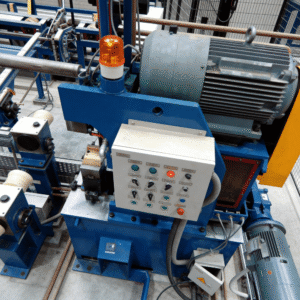
The complete operation flow of the OCTG pipe end finishing machine follows standardized automated procedures, from pipe feeding to finished product discharging, with smooth and efficient links. The whole process requires no manual intervention, which significantly improves production efficiency and reduces labor costs. The detailed processing steps are as follows:
Step 1: Automatic Pipe Feeding & Positioning
The unprocessed OCTG pipes are transported to the equipment processing area through the front-end conveyor line. The infrared sensing system automatically detects the pipe specification and position, and transmits the signal to the CNC control system. The positioning mechanism fine-tunes the pipe position to ensure the pipe end accurately reaches the processing origin, preparing for subsequent clamping and cutting.
Step 2: Precise Clamping & Fixing
After positioning is completed, the hydraulic clamping system acts quickly to clamp the pipe body stably. The multi-point clamping design ensures uniform stress on the pipe, effectively preventing pipe shaking and displacement during high-speed cutting. For large-diameter and heavy-wall oil casing pipes, the equipment is equipped with enhanced clamping dies to improve fixing stability and processing safety.
Step 3: CNC Parameter Calling & Processing Startup
According to the pipe model, diameter and wall thickness, the operator calls the preset CNC program. The system automatically matches the optimal spindle speed, feed rate, chamfer angle and cutting depth parameters. After confirming the parameters are correct, start the automatic processing cycle.
Step 4: Synchronous End Facing & Chamfering Processing
The spindle drives the cutting head to rotate at a constant speed and feed forward stably. The equipment completes three core operations in one cycle: trimming the uneven pipe end to form a flat vertical end face, cutting standard outer chamfer (15°-30° conventional angles) on the outer edge of the pipe end, and processing smooth inner chamfer and deburring on the inner wall of the pipe end. The whole process is synchronized and completed at one time without secondary positioning, which greatly shortens the processing cycle.
Step 5: Cooling, Chip Removal & Precision Detection
During the cutting process, the circulating cooling system continuously sprays cooling liquid to reduce cutting temperature and protect the blade and pipe base material. The automatic chip removal mechanism collects metal scraps centrally. After processing, the equipment’s built-in detection system automatically checks the flatness of the pipe end face and the dimensional accuracy of the chamfer to ensure compliance with API standards. Unqualified products will be automatically alarmed and marked.
Step 6: Clamp Release & Automatic Discharging
After passing the detection, the spindle resets, the clamping mechanism loosens the pipe, and the finished pipe is transported to the next process (threading, inspection, packaging) through the rear conveyor line. Then the equipment automatically resets and enters the next processing cycle, realizing continuous batch production.
4. Main Types of OCTG End Facing & Chamfering Machines
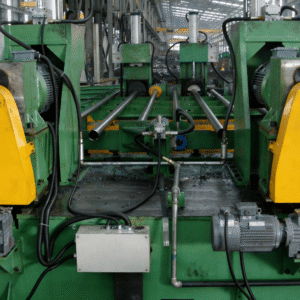
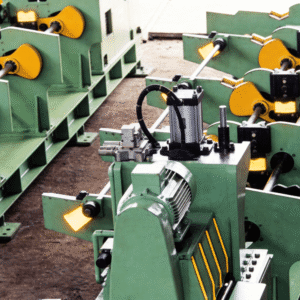
According to structural design, processing efficiency, automation level and processing mode, mainstream tubing chamfering production line equipment on the market is divided into three core types. Each type has unique advantages and applicable scenarios, helping customers select targeted equipment according to production scale and processing requirements.
4.1 Single-Head End Facing & Chamfering Machine
The single-head chamfering machine is equipped with only one set of spindle cutting system, which can process a single end of a single OCTG pipe in one cycle. It features simple structure, low failure rate, flexible operation and low equipment investment cost. This type of equipment is suitable for small and medium-sized processing plants with low production volume and diversified product specifications, and can adapt to frequent switching of casing and tubing of different calibers.
Although the single-head model has relatively low production efficiency, it has strong versatility, small floor space and low maintenance cost. It is the preferred equipment for small-batch, multi-specification OCTG pipe finishing and after-sales reprocessing of defective pipes.
4.2 Double-End Synchronous Facing & Chamfering Machine
As the mainstream high-efficiency model in the market, the double-end machine is equipped with two sets of symmetrical spindle cutting systems, which can simultaneously complete end facing and chamfering operations on both ends of the OCTG pipe in one clamping. Compared with the single-head model, its production efficiency is doubled, and the processing consistency of both pipe ends is higher.
This equipment is fully CNC-controlled, with high processing precision and stable performance. It is specially designed for mass production of conventional oil casing and tubing. It can perfectly match the continuous operation rhythm of large-scale OCTG production line, and is widely used in professional OCTG pipe manufacturing enterprises with medium and large production volume.
4.3 Multi-Pipe High-Speed Chamfering & Facing Machine
The multi-pipe high-speed model is a high-end customized equipment for large-scale standardized production. It adopts multi-station parallel processing design, which can complete end finishing of multiple small and medium-diameter OCTG pipes in a single cycle. The equipment is equipped with an automatic feeding and sorting system, realizing unmanned continuous production.
With ultra-high production efficiency and intelligent control system, this model is suitable for large factories with fixed product specifications and ultra-large production volume. It can greatly save labor costs and improve production capacity, but the equipment investment and floor space are larger, which is more suitable for standardized large-scale OCTG pipe production bases.
4.4 Full CNC Intelligent Chamfering & Facing Machine
Different from ordinary semi-automatic equipment, the full CNC intelligent model adopts a full digital control system, which can store dozens of processing programs, realize one-key switching of different pipe specifications, and support custom chamfer angles and special-shaped end face processing. It has automatic error correction, real-time data monitoring and production data statistics functions, which is convenient for factory production management and quality traceability.
This type of equipment has the highest processing precision, fully meets the high-standard manufacturing requirements of high-end oil and gas pipes, and is the preferred equipment for high-precision OCTG pipe export processing and high-end energy engineering supporting pipes.
5. How to Choose the Right OCTG End Facing & Chamfering Machine?
For global purchasers, equipment selection should comprehensively consider production scale, pipe specifications, precision requirements and budget. For small-batch and multi-specification processing, single-head flexible equipment is cost-effective; for conventional mass production, double-end synchronous processing equipment is the most cost-effective; for large-scale standardized production and high-precision export orders, full CNC intelligent or multi-pipe high-speed equipment is more suitable.
In addition, professional OCTG end facing and chamfering machine must have API standard processing capability, stable hydraulic clamping system, high-precision spindle and durable alloy blades, to ensure long-term stable operation and consistent product qualification rate, creating higher production benefits for enterprises.
6. Conclusion
As the core finishing equipment of the OCTG production line, the end facing & chamfering machine directly determines the dimensional accuracy, assembly performance and product quality grade of oil and gas pipes. With stable working principle, standardized operation process and diversified product types, it can meet the processing needs of different production scales and specification requirements. Understanding the equipment’s working logic and classification characteristics can help overseas customers quickly select suitable CNC pipe chamfering equipment to optimize production efficiency and product competitiveness in the global OCTG pipe market.
 English
 Español
 Русский
 العربية
 Français
 Português