
Introduction
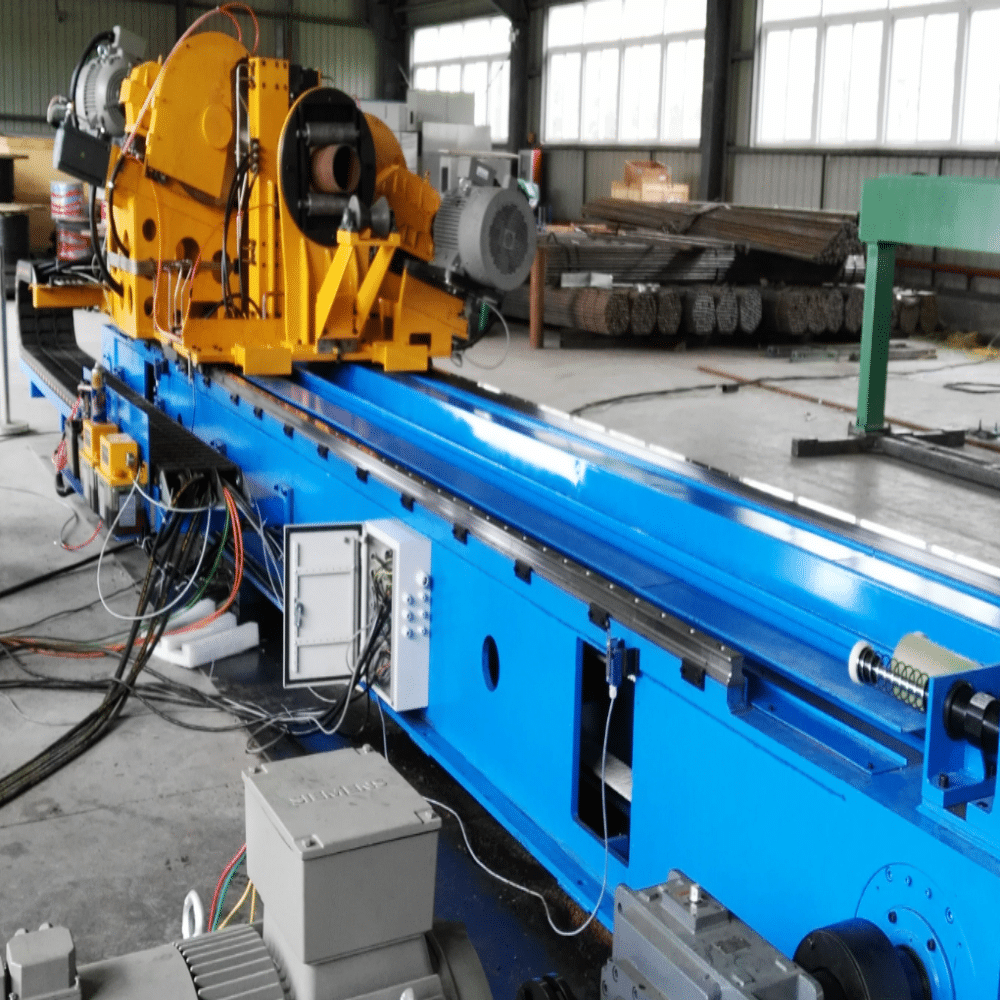
In continuous ERW (Electric Resistance Welding) tube manufacturing lines, the flying cut-off station is one of the most critical finishing units. It performs on the fly cutting for continuously moving tubes after sizing, without stopping the mill production rhythm. For modern ERW tube mills targeting premium pipe quality, two dominant cold cutting technologies stand out: Cold Flying Saw and Milling Cold Cut-off. Both eliminate the defects of traditional friction hot saw such as burnt pipe ends, heavy burrs, large heat affected zone and massive sparks, yet they differ fundamentally in mechanical structure, cutting kinematics, capacity envelope and economic performance……
Many tube mill engineers and plant managers struggle to decide which system best fits their product mix, line speed targets and capital budget. This article explains the mechanical working principle of each machine, compares practical application scenarios, lists core advantages and limitations, and summarizes actionable selection principles to help you make optimal investment decisions for new ERW lines or existing mill retrofits.
1. Working Principle of Cold Flying Saw
Cold Flying Saw is a servo synchronized flying cold cut-off machine, widely installed in the finishing zone right after the sizing stand of ERW tube mill lines.
Mechanical Principle
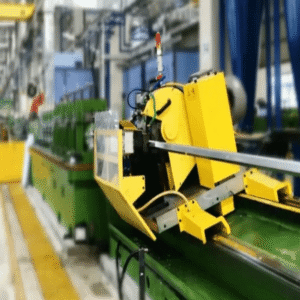
The whole unit consists of servo travelling carriage, hydraulic/pneumatic tube clamping assembly, high torque saw spindle, TCT (Tungsten Carbide Tipped) circular cold saw blade, coolant delivery system, encoder length measuring unit and PLC motion controllerSRET.
When continuous ERW tube runs through the measuring roller, the high resolution encoder feeds real time tube speed and accumulated length data to the motion control system. Once the preset cutting length is reached, the servo driven carriage accelerates rapidly to fully synchronize its travelling speed with the running tube line speed. Hydraulic clamps lock the tube firmly to eliminate relative vibration during cutting. The carbide tipped circular saw rotates at controlled low to medium RPM with constant torque, performing complete through cut across the whole tube cross section in one single pass. Coolant fluid is sprayed continuously to evacuate chips and dissipate minimal cutting heat, keeping pipe end temperature low, hence the term “cold cutting”. After cutting completion, clamps release, the carriage decelerates and returns to home position for the next cutting cycle, while the cut pipe segment transfers to run out table for downstream handling.
Core kinematics feature: single circular saw blade penetrates full tube wall and entire tube diameter in one cutting stroke. All cutting forces are borne by the saw blade itself.
Key Performance Characteristics
- Cutting mechanism: complete circular sawing, chip removal by single TCT saw blade
- Heat affected zone: nearly zero, no tube end discoloration
- Typical applicable range: OD from 16 mm up to 168 mm; wall thickness 0.8 ~ 6.0 mm carbon steel, alloy steel and stainless steel tubes
- Typical line speed adaption: 20-80 m/min
- Length tolerance: ±0.5 ~ ±1.0 mm
- Pipe end quality: low burr, square cut surface; minimal secondary deburring workload
- Consumables: solid TCT circular saw blades; blade cost is relatively high for larger diameters.
2. Working Principle of Milling Cold Cut-off
Milling Cold Cut-off (also known as flying milling saw, double-head milling cut-off) is another mature cold cutting solution for mid to large size ERW tubes, increasingly adopted for structural pipe, OCTG semi-finished tubes and large-diameter structural tube lines.
Mechanical Principle
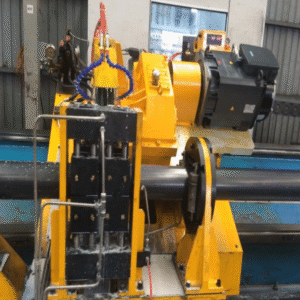
Different from single-blade full penetration sawing of Cold Flying Saw, Milling Cold Cut-off adopts peripheral milling chip removal philosophy. The system is also built on servo synchronized flying carriage, heavy duty clamping mechanism, PLC servo motion control and closed loop length measurement. However, instead of one large-diameter circular saw, it uses one or multiple smaller diameter carbide milling cutter heads arranged around the tube circumference.
During cutting cycle: the travelling carriage synchronizes precisely with running ERW tube; heavy duty hydraulic clamps secure the tube body. Each milling cutter head rotates at high peripheral speed and feeds radially into tube wall. Instead of cutting through the whole tube in one pass, each milling tool only cuts a partial segment of tube wall. Multiple cutters work in coordination along tube circumference, removing material layer by layer by milling chips until full tube separation is achieved. Continuous high pressure coolant flushes away fine milling chips and controls cutting temperature. Upon cut completion, clamps open; carriage resets for next cycle.
Core kinematics feature: peripheral segmented milling, multi-cutters remove wall material incrementally around tube circumference, no single blade needs to span full tube diameter.
Key Performance Characteristics
- Cutting mechanism: peripheral segmented milling, multiple carbide milling heads remove tube wall material chip by chip
- Heat affected zone: very low, clean metallic pipe end without burning
- Typical applicable range: OD 114 mm up to 273 mm or larger; wall thickness 1.0 ~ 10 mm carbon steel and alloy steel tubes
- Typical line speed adaption: up to 120 m/min for medium large tube
- Length tolerance: ±0.5 mm typical
- Pipe end quality: excellent squareness, extremely low burr; well suited for downstream beveling, threading and hydro-testing
- Consumables: replaceable carbide milling inserts; insert re-grinding is possible to lower running cost.
3. Application Differences Between Cold Flying Saw and Milling Cold Cut-off
Although both technologies realize cold flying cut-off without mill stop, their suitable application scenarios show clear divergence in tube dimension envelope, line speed, material grade, downstream process requirement and total operating cost.
3.1 Tube Outer Diameter & Wall Thickness
Cold Flying Saw excels for small to medium OD tubes below 168 mm. When tube OD grows larger, the required single saw blade diameter increases sharply, driving up blade cost, machine dimension and cutting load dramatically. For thick wallness tubes over 6 mm, single blade cold flying saw suffers heavy cutting resistance, higher risk of blade chipping and shortened service life.
Milling Cold Cut-off shines for medium to large OD tubes starting from 114 mm up to 273 mm and above. Since each milling cutter only engages partial tube wall, cutter diameter does not need to match full tube OD. It handles thicker wall tubes more stably, with lower peak cutting torque requirement on main spindle, making it preferred choice for large-size ERW structural pipe and semi-finished OCTG tube production.
3.2 Production Line Speed
Cold Flying Saw fits medium speed ERW lines. When line speed exceeds 80 m/min for medium size tubes, the single blade full penetration cutting time becomes difficult to fit within the available synchronous travelling stroke of flying carriage, which limits maximum achievable mill speed.
Milling Cold Cut-off can support higher line speed up to 100-120 m/min for medium-large tubes. Segmented distributed milling reduces single-stroke cutting duration, making it more compatible with high output large diameter ERW tube mills.
3.3 Pipe End Quality & Downstream Processes
Both produce far superior pipe end quality compared with traditional friction hot saw.Cold Flying Saw delivers smooth, square end surface for small-medium tubes. It is ideal for furniture tube, automotive tubing, HVAC and general purpose structural tube where moderate end quality is acceptable. Minor residual burr may remain on inner diameter side for thicker wall tubes, requiring light deburring.
Milling Cold Cut-off provides outstanding end squareness and near burr-free profile. The milled pipe ends are ready for subsequent operations such as pipe end facing, beveling, threading, hydrostatic test, directly matching API pipe production requirements, greatly reducing secondary finishing workload.
3.4 Material Compatibility
Cold Flying Saw works well for carbon steel, low alloy steel and thin wallness stainless steel. When processing high strength thick wallness steel grades, single blade impact load increases blade breakage risk.
Milling Cold Cut-off shows better adaptability for high-strength carbon steel and alloy steel grades. Milling cutting disperses cutting force across multiple tool points, reducing shock load on each single carbide insert.
3.5 Capital Investment & Running Cost
Cold Flying Saw has relatively lower initial machine investment for small-medium tube sizes. However, large solid TCT circular saw blades are expensive consumables, and blade replacement frequency rises for thick-wall or high-strength materials, pushing up long-term operating cost.
Milling Cold Cut-off requires higher upfront capital expenditure because of complex multi-head mechanical assembly and sophisticated servo synchronous system. Nevertheless, consumable cost is lower in mass production: only small carbide inserts need replacement, and inserts can be re-ground multiple times before disposal. For high-volume large-tube production, total cost of ownership often turns out favourable.
4. Core Selection Principles for ERW Tube Mill Engineers
Selecting between Cold Flying Saw and Milling Cold Cut-off should not depend only on equipment price. You need to evaluate your product mix, mill specification, downstream workflow and total cost of ownership perspective. Below are actionable selection guidelines.
Principle 1: Match equipment with your main tube dimension range
- Choose Cold Flying Sawif your primary production covers OD 16 -168 mm, wall thickness ≤6 mm. It delivers satisfying performance with balanced investment for small-medium ERW tube mills producing furniture tubes, automotive tubing, light structural tubes.
- Choose Milling Cold Cut-offif your main products are OD ≥114 mm medium-large tubes, wall thickness above 6 mm, including structural steel pipe, API semi-finished tubes. Even if you have overlapping 114-168 mm production window, evaluate production volume: high volume large tube output favours milling cold cut-off.
Principle 2: Align with your ERW line maximum running speed
Check your sizing mill maximum line speed. If your target line speed is below 80 m/min for small-medium tubes, Cold Flying Saw can satisfy production targets. If you run high speed large diameter ERW mill over 80 m/min, Milling Cold Cut-off is more technically feasible.
Principle 3: Consider downstream processing requirements
If your workshop has separate pipe-end facing and deburring stations and can accept minor post cut finishing work, Cold Flying Saw is a viable option.If your finished tubes go directly to hydro-tester, pipe end beveling, threading, or API standard delivery with strict end squareness requirement, Milling Cold Cut-off is strongly recommended to cut secondary processing labour and cycle time.
Principle 4: Evaluate material grades and production batch volume
For low to medium volume production with mixed small-medium tube sizes: Cold Flying Saw offers good flexibility.For mass continuous production focusing on large diameter high strength alloy steel tubes: Milling Cold Cut-off brings lower long-term tooling cost and higher uptime.
Principle 5: Balance capital budget vs total cost of ownership
Do not make decisions purely based on initial purchase price. Calculate total cost including spare-part consumption, blade/insert cost, downtime loss for tool change, labour for secondary pipe-end finishing. A higher upfront investment for Milling Cold Cut-off often generates long-run savings for high volume large tube plants.
5. Conclusion
Cold Flying Saw and Milling Cold Cut-off represent two advanced cold on the fly cutting technologies for modern ERW tube mill lines, both eliminating the major drawbacks of conventional friction hot saw cutting.
Cold Flying Saw applies single TCT circular saw blade for full cross section cutting, best suited for small to medium OD tubes below 168 mm, medium line speed and general purpose tube production with moderate end quality requirements.
Milling Cold Cut-off uses multi-head peripheral segmented milling principle. It targets medium to large diameter tubes, handles thicker walls and higher line speeds, delivering superior pipe-end squareness for API and high grade structural pipe production, despite higher initial capital cost.
When upgrading your existing ERW tube mill or planning new production lines, clarify your product portfolio, line speed objective and downstream processing workflow first. Proper selection of flying cut-off equipment will improve final pipe quality, reduce post processing cost, maximize mill uptime and bring tangible profit improvement for your tube manufacturing business.
 English
  Español
  Русский
  العربية
  Français
  Português