Overview of OCTG Heat Treatment System & Core Value
OCTG pipes operate in extreme downhole environments featuring high pressure, high temperature, hydrogen sulfide corrosion, and alternating load impact. Untreated seamless steel pipes after rolling often have defects such as uneven grain distribution, large internal residual stress, unstable hardness, and poor toughness, which cannot meet the strict service requirements of petroleum and gas drilling engineering. The integrated heat treatment production line is a dedicated intelligent equipment system designed for OCTG tubular thermal processing, mainly divided into two mainstream technical routes: traditional furnace-type heat treatment and medium-frequency induction heat treatment. At present, the induction quenching and tempering integrated production line has become the mainstream configuration of high-end OCTG factories due to its advantages of fast heating, uniform temperature, precise control, and low energy consumption.
Different from conventional metal heat treatment equipment, OCTG special heat treatment equipment is customized for the tubular hollow symmetrical structure. It solves industry pain points such as inconsistent internal and external wall temperature, pipe body bending and deformation, local soft spots, and uneven hardness of long steel pipes. Through standardized quenching and tempering (Q&T) composite process, it realizes precise regulation of metallographic structure, makes OCTG products obtain stable martensite or tempered sorbite structure, and balances high strength, low temperature toughness, and stress corrosion resistance, fully complying with API 5CT international industry standards.
Core Working Principle of OCTG Heat Treatment Equipment
Modern high-efficiency OCTG heat treatment production lines mainly rely on medium-frequency electromagnetic induction heating technology, supplemented by closed-loop constant temperature control and high-pressure uniform cooling systems. The core working principle is based on electromagnetic induction, eddy current thermal effect, and metallographic phase transformation kinetics, realizing controllable rapid heating and directional structure improvement of steel pipes.
Induction Heating Core Mechanism
The equipment generates a variable alternating magnetic field through the medium-frequency power supply and induction coil. When the steel pipe passes through the magnetic field, the changing magnetic line of force penetrates the pipe wall, inducing closed eddy current inside the steel pipe based on Faraday’s electromagnetic induction law. Driven by the internal resistance of the steel material, the eddy current rapidly converts electric energy into thermal energy, realizing integral and rapid heating of the pipe wall. Different from flame heating and resistance heating with slow heat conduction, induction heating belongs to internal heat generation of the workpiece, which avoids the temperature difference between the surface and core caused by external heat conduction.
The production line adopts a four-supply medium-frequency power supply architecture and helical-angle roller conveying structure. The magnetic field distribution is optimized through the coil layout, so that the circumferential and axial heating temperature of the steel pipe is highly consistent. Equipped with an infrared real-time temperature detection module, the system forms a PLC closed-loop control logic, dynamically adjusts the heating power and conveying speed according to the pipe diameter, wall thickness, and steel grade, and accurately locks the austenitizing temperature and tempering temperature to ensure no soft spots and no overheating on the entire pipe body.
Metallographic Phase Transformation Principle
The fundamental purpose of OCTG heat treatment is to trigger directional phase transformation of steel microstructure through precise temperature control, so as to optimize mechanical properties. In the quenching stage, when the steel pipe is rapidly heated to 850–950℃ (austenitizing temperature range), the original ferrite and pearlite structures are completely transformed into uniform austenite grains. After high-pressure rapid cooling, the austenite is rapidly transformed into dense martensite structure, which significantly improves the hardness and tensile strength of the steel pipe.
However, pure martensite structure has high brittleness and large internal quenching stress, which is easy to cause cracking and sulfide stress corrosion in downhole service. Therefore, the tempering process is essential. By reheating the quenched steel pipe to 400–700℃ (subcritical temperature), the martensite structure is decomposed and transformed into stable tempered sorbite, which effectively eliminates residual internal stress, improves ductility and toughness, and realizes the optimal balance of strength, hardness and toughness of OCTG pipes.
Uniform Cooling & Shaping Principle
The cooling system is the key link to determine the dimensional accuracy and performance consistency of OCTG pipes. The equipment adopts an annular high-pressure spray quenching structure, which surrounds the steel pipe in all directions. The high-pressure cooling medium (pure water or quenching liquid) is uniformly sprayed on the inner and outer walls of the pipe at a fixed flow rate and pressure, realizing synchronous and rapid cooling of the entire pipe wall. Compared with traditional immersion quenching, spray quenching avoids uneven cooling and pipe body deformation caused by liquid flow dead zones. The subsequent slow cooling shaping process further stabilizes the pipe body size and eliminates micro-deformation generated during quenching.
Complete Standard Process Flow of OCTG Heat Treatment Production Line
The industrialized OCTG heat treatment production line adopts a fully automated continuous processing mode. The whole process is unattended, covering feeding, preheating, quenching heating, high-pressure quenching cooling, tempering heating, slow cooling shaping, detection and discharging. The standardized process flow ensures batch production consistency of OCTG products and meets the mass production demand of high-standard petroleum pipes.
Pre-feeding & Preheating Preparation
The rolled and sized OCTG steel pipes are automatically sorted and conveyed to the production line through the roller table. The system firstly performs pipe diameter, wall thickness and length detection to match the corresponding process parameters. The preheating section adopts low-power uniform heating to raise the pipe body temperature to 200–300℃, which eliminates the temperature gradient of the pipe body, avoids cracking caused by rapid high-temperature heating, and improves the subsequent austenitizing uniformity. At the same time, the residual oxide scale and moisture on the pipe surface are removed to ensure the stability of the heating process.
Rapid Austenitizing & High-pressure Quenching
This is the core process to improve the strength and hardness of OCTG pipes. The preheated steel pipe enters the medium-frequency induction quenching furnace, and is rapidly heated to the set austenitizing temperature according to the steel grade standard. Low-grade OCTG such as J55 and K55 adopts conventional normalizing heating, while high-strength grades such as L80 and P110 adopt high-temperature rapid austenitizing. After the temperature is stabilized and the grain structure is uniform, the steel pipe immediately enters the full-circumference spray quenching zone. The high-pressure cooling system cools the pipe wall at a fixed cooling rate, completes rapid phase transformation of austenite to martensite, and obtains high-strength quenched structure. The whole heating and quenching process is precisely controlled by the system to avoid overheating, underheating and incomplete quenching.
Precision Tempering & Stress Relief
After quenching, the steel pipe has high hardness but poor toughness and large residual stress. The tempering section uses independent medium-frequency induction equipment for secondary uniform heating. According to the performance requirements of different OCTG grades, the tempering temperature is accurately adjusted in the range of 400–700℃. The constant temperature holding time is matched with the pipe wall thickness to ensure sufficient decomposition of martensite, full release of internal stress, and formation of stable and tough tempered sorbite structure. This process fundamentally solves the brittleness problem of quenched steel and improves the low-temperature impact resistance and stress corrosion resistance of OCTG pipes, which is the key to ensure the long-term downhole service safety of products.
Slow Cooling Shaping & Post-processing Detection
After tempering, the steel pipe enters the closed slow cooling zone for natural uniform cooling, which avoids secondary deformation caused by rapid cooling. After cooling to room temperature, the pipe body is straight and the size is stable. Subsequently, the production line is linked with the performance detection system to conduct online detection of hardness, tensile strength, impact toughness and pipe straightness. Unqualified products are automatically screened out, and qualified OCTG finished pipes enter the subsequent threading, surface treatment and packaging processes.
Core Equipment Composition & Technical Advantages
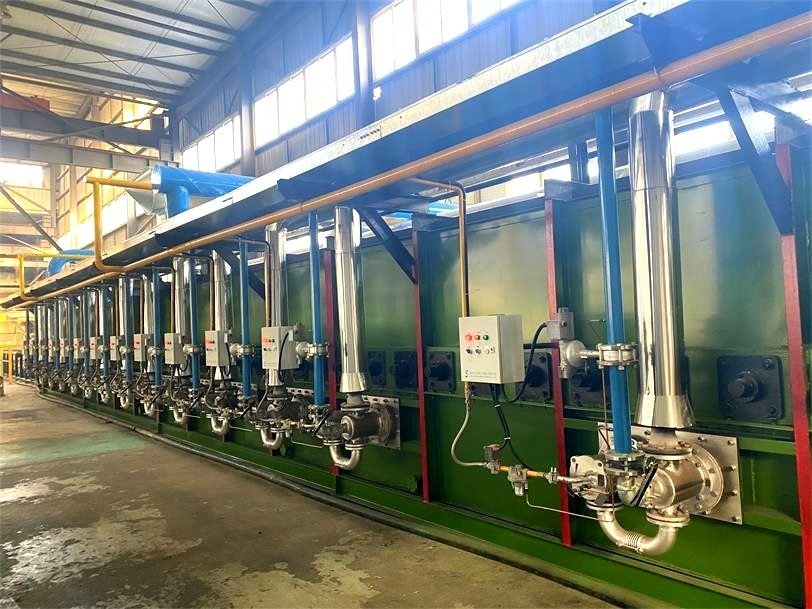
A complete OCTG heat treatment production line consists of medium-frequency power supply system, induction heating furnace body, intelligent conveying system, high-pressure quenching cooling system, infrared temperature closed-loop control system, and online detection system. Compared with traditional box-type furnace heat treatment equipment, the integrated induction heat treatment line has obvious technical advantages in industrial production.
First, it achieves uniform heating and stable performance. The circumferential uniform heating design and closed-loop temperature control system ensure that the temperature error of the entire pipe body is controlled within ±5℃, no soft spots or hard spots appear, and the mechanical performance consistency of batch products is extremely high. Second, it features high efficiency and energy saving. Induction internal heating mode has high thermal efficiency, short heating cycle, and saves more than 30% energy compared with traditional furnace heating, which is suitable for continuous mass production. Third, it realizes low deformation and high precision. The rotary forward feeding and synchronous cooling structure effectively suppresses pipe bending and ovality deformation, ensuring the dimensional accuracy of finished pipes.
In addition, the intelligent PLC control system realizes one-click parameter switching for different pipe diameters, wall thicknesses and steel grades, with strong process flexibility. It can meet the heat treatment production requirements of all API 5CT standard OCTG products, and can adapt to the processing of special high-corrosion resistant and high-strength petroleum pipes, with wide industrial applicability.
Key Process Control Points & Quality Optimization Logic
The performance of OCTG heat treatment products depends on the precise control of three core parameters: heating temperature, holding time, and cooling rate. Excessively high austenitizing temperature will cause coarse grain growth and reduce pipe toughness; excessively low temperature will lead to incomplete phase transformation and insufficient strength. Unreasonable cooling rate will cause uneven structure and residual stress concentration, which easily leads to sulfide stress cracking in sour oil and gas wells.
In industrial production, the equipment formulates differentiated process schemes according to product grades: low-strength J55/K55 pipes adopt normalizing heat treatment to refine grains and improve ductility; medium and high-strength L80/P110 pipes adopt strict quenching and tempering composite process to realize high strength and high toughness matching. At the same time, through real-time temperature monitoring and dynamic parameter adjustment, the equipment eliminates the performance difference caused by raw material fluctuation and equipment operation deviation, ensuring that each batch of OCTG products meets the standard requirements.
Conclusion & Industrial Application Value
Heat treatment equipment is the core guarantee for the performance upgrading of OCTG products. The modern induction quenching and tempering integrated production line relies on electromagnetic induction heating principle and precise metallographic control technology, which solves the common quality problems of traditional thermal processing such as uneven performance, large deformation, high energy consumption and low efficiency. Through standardized quenching, tempering and slow cooling process, it realizes accurate regulation of OCTG steel microstructure and mechanical properties.
With the continuous upgrading of oil and gas exploitation conditions, higher requirements are put forward for the strength, toughness and corrosion resistance of OCTG pipes. Optimizing the operation parameters of heat treatment equipment and improving the precision and stability of the thermal processing process can effectively improve the service life and safety of downhole tubular products, reduce engineering maintenance costs, and provide strong technical support for high-quality and high-efficiency production of the petroleum pipe manufacturing industry.
 English
  Español
  Русский
  العربية
  Français
  Português