Resumen
In the oil and gas industry, Oil Country Tubular Goods (OCTG) including casing, tubing, and drill pipes serve as the core infrastructure for downhole drilling and oil extraction operations. The threaded connections between OCTG pipes and couplings directly determine the tightness, pressure resistance, and service life of the entire pipeline system. Even minor thread assembly errors or inconsistent torque values can lead to thread leakage, connection failure, or downhole safety accidents during high-pressure and high-temperature mining.
This makes pre-tightening and bucking machines indispensable core equipment in modern OCTG production lines. As professional thread make-up and break-out devices, they deliver precise torque control, standardized thread assembly, and non-damage pipe clamping, fully complying with API 5CT international industry standards. For OCTG manufacturers and oilfield service providers, high-performance pre-tightening and bucking machines are the key to improving product qualification rates, reducing production costs, and enhancing market competitiveness. This blog will comprehensively elaborate on the working principle, mainstream types, core advantages, and industrial applications of OCTG pre-tightening and bucking machines to help global buyers select suitable pipe threading assembly equipment.
1. What Is an OCTG Pre-tightening and Bucking Machine?
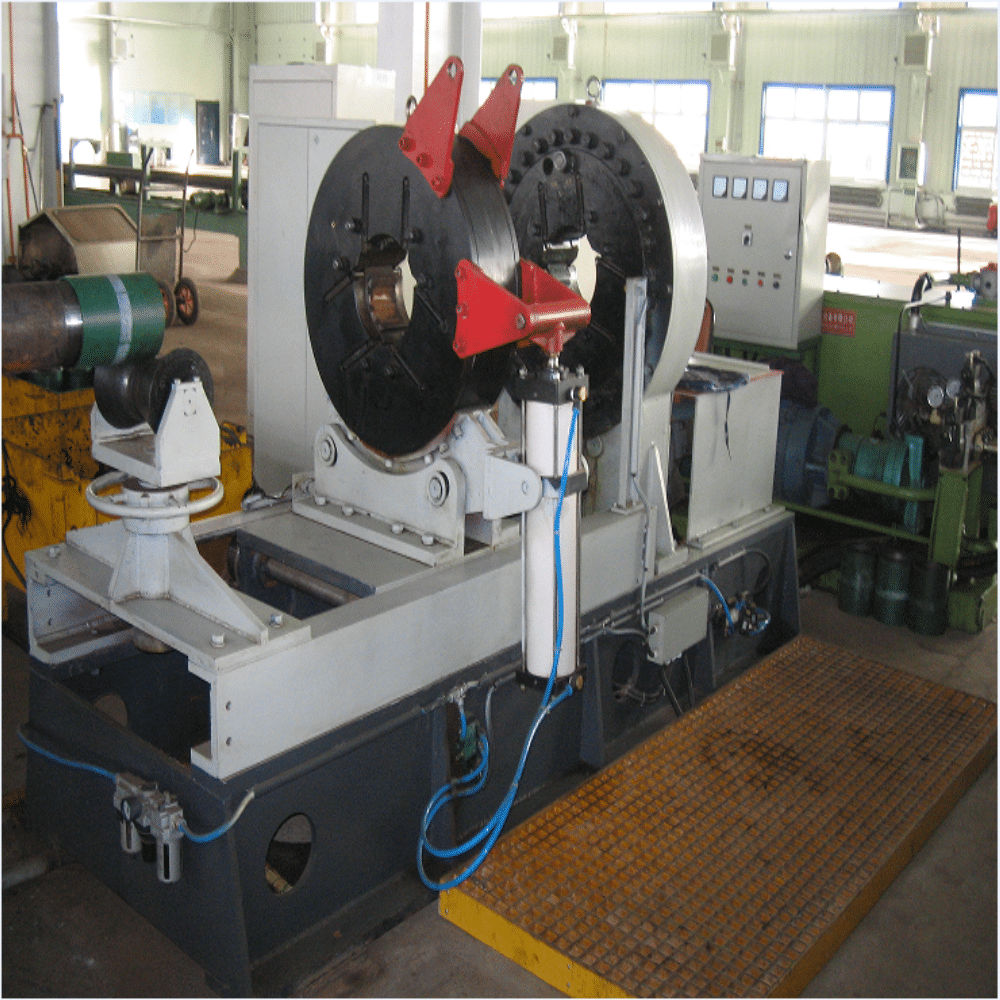
An OCTG pre-tightening and máquina de montar is special automated processing equipment designed for threaded connection assembly and disassembly of casing, tubing, and drill pipes. It is mainly used for pre-tightening (pre-makeup) and final bucking (precision makeup) of pipe couplings, as well as thread break-out for defective products or maintenance.
Different from traditional manual or semi-automatic pipe threading tools, industrial-grade bucking machines integrate mechanical clamping, hydraulic/electric power drive, PLC intelligent control, and torque-turn monitoring systems. They realize one-stop precision assembly of OCTG threads, effectively solving the problems of uneven manual torque, thread scratching, low efficiency, and poor consistency. All processing procedures strictly follow API 5CT specifications, ensuring that each pipe connection meets the sealing and mechanical strength requirements of downhole complex working conditions.
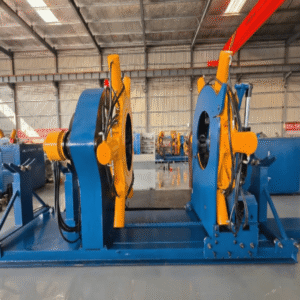
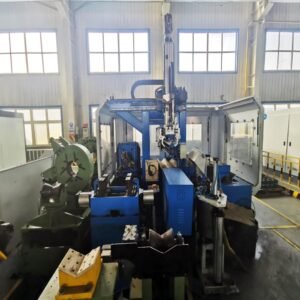
2. Working Principle of OCTG Pre-tightening and Bucking Machine
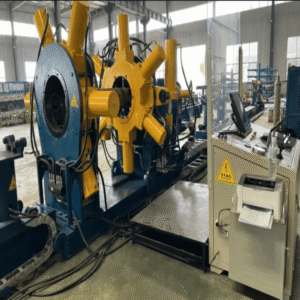
The complete working flow of the pre-tightening and bucking machine is divided into four core stages: pipe positioning, pre-tightening, precision bucking, and torque verification and reset. The whole process adopts closed-loop control to ensure high precision and non-damage operation, and the detailed working principle is as follows:
2.1 Pipe Centering and Clamping Positioning
First, the operator places the OCTG pipe and matching coupling on the machine’s support platform. The equipment’s automatic centering system adjusts the pipe axis in real time to ensure the pipe and coupling are completely coaxial, avoiding thread deflection and eccentric wear during assembly. Then, the fixed clamping jaw and movable backup jaw stably clamp the pipe body through hydraulic pressure. The high-hardness non-slip clamping die ensures firm fixation without squeezing or scratching the pipe surface, laying a foundation for precise thread meshing.
2.2 Low-speed Pre-tightening (Thread Pre-makeup)
Pre-tightening is a key pre-process for formal bucking. The equipment drives the coupling to rotate at a low and uniform speed through the power system, realizing preliminary meshing of internal and external threads. In this stage, the system adopts low-torque flexible drive to prevent thread jamming, scratching, or tooth breakage caused by forced assembly. The pre-tightening process eliminates thread gaps, ensures complete fitting of thread teeth, and prepares for subsequent precision torque locking.
2.3 High-precision Bucking and Torque Locking
After the completion of pre-tightening, the system automatically switches to the formal bucking stage. Driven by hydraulic or servo electric power, the machine applies standard rated torque to the coupling for precise locking. Equipped with a high-sensitivity tension sensor and real-time torque-turn monitoring module, the equipment dynamically tracks torque changes and rotation turns during the bucking process. Once the preset standard torque value specified by API 5CT is reached, the system instantly stops driving to avoid over-torque thread damage or under-torque sealing failure.
2.4 Data Verification and Automatic Reset
After bucking is completed, the built-in PLC control system automatically records key data including final torque value, rotation turns, and assembly time. The system compares the actual data with the standard parameter range to judge whether the thread connection is qualified. Qualified products are unclamped and discharged automatically; unqualified products will be alarmed and marked for secondary processing. Finally, the equipment resets the parameters and clamping mechanism to complete a full working cycle.
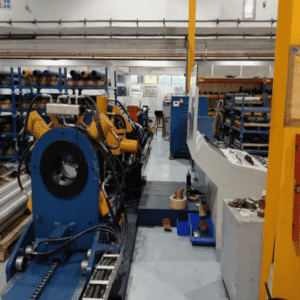
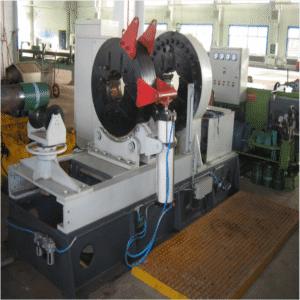
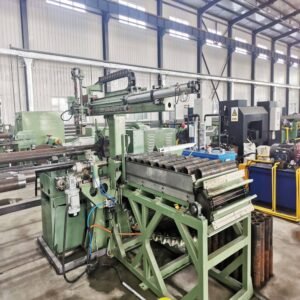
3. Main Types of OCTG Pre-tightening and Bucking Machines
According to power mode, automation level, and structural layout, mainstream OCTG pre-tightening and bucking machines on the market can be divided into three categories, each with unique performance characteristics and applicable scenarios, meeting the differentiated production needs of small processing plants and large-scale OCTG manufacturing enterprises.
3.1 Hydraulic Bucking Machine
Hydraulic bucking machines are the most widely used traditional OCTG threading assembly equipment, powered by a hydraulic pump station and hydraulic motor. They feature strong power, stable output torque, and large clamping force, and are suitable for heavy-duty processing of large-diameter casing and thick-walled drill pipes.
Core advantages: Super high torque output, strong adaptability to high-strength premium threads, stable operation under heavy load, and long service life. The hydraulic overflow valve can realize automatic pressure relief and stop, effectively preventing pipe thread damage caused by overload. Applicable scope: Large-diameter OCTG pipes (2 7/8″~15″), heavy casing, and drill pipe thread make-up and break-out, suitable for large-scale industrial production lines.
3.2 Electric Servo Bucking Machine
As an upgraded new-generation equipment, electric servo bucking machines adopt servo motor + precision reducer power configuration, replacing the traditional hydraulic drive system. This type of machine realizes stepless speed regulation and high-precision torque control, with more accurate and stable operating parameters than hydraulic equipment.
Core advantages: High torque control accuracy (error controlled within ±1%), low noise, energy-saving and environmentally friendly, no hydraulic oil leakage pollution, and more intuitive data monitoring. It can precisely adapt to premium metal-to-metal sealing threads with extremely strict tolerance requirements. Applicable scope: High-precision tubing, premium connection OCTG pipes, and small and medium-diameter oil pipe finishing processing, suitable for high-end product production scenarios.
3.3 Semi-automatic vs Fully Automatic Bucking Machine
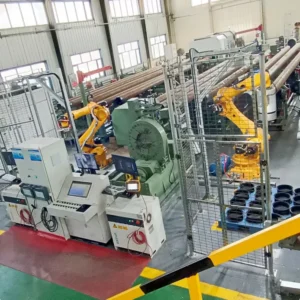
From the perspective of automation, bucking machines are divided into semi-automatic and fully automatic models. Semi-automatic equipment requires manual feeding and auxiliary positioning, with automatic torque bucking, featuring low cost and simple operation, suitable for small factories and batch-variable processing. Fully automatic bucking machines are equipped with automatic feeding, centering, bucking, discharging, and data statistical systems, realizing unmanned continuous production, with extremely high production efficiency and consistent product quality, which is the mainstream configuration of modern intelligent OCTG production lines.
4. Core Industrial Applications of Pre-tightening and Bucking Machines in OCTG Production
Pre-tightening and bucking machines run through the entire OCTG production, inspection, and maintenance links, covering pipe factory finishing, oilfield on-site assembly, product quality testing, and equipment maintenance, with wide industrial application value.
4.1 OCTG Factory Finishing Production
In professional OCTG manufacturing plants, bucking machines are used for batch assembly of casing and tubing couplings. After pipe threading processing, the equipment completes standardized pre-tightening and precision bucking of couplings to ensure that each finished pipe meets API 5CT standard connection performance. The unified torque parameter control effectively improves the consistency of batch products, reduces manual operation errors, and increases the finished product qualification rate to more than 99%.
4.2 Premium Thread Connection Processing
Premium threaded connections with metal-to-metal seals are widely used in deep well, ultra-deep well, and high-pressure oil and gas mining scenarios, with extremely strict assembly requirements. Fully automatic servo bucking machines rely on high-precision torque-turn synchronous monitoring technology to realize zero-defect assembly of premium threads, ensuring the air tightness and structural stability of pipe connections under extreme downhole working conditions.
4.3 Oilfield On-site Assembly and Maintenance
Mobile and portable bucking equipment can be applied to on-site pipe assembly, disassembly, and maintenance of oilfield drilling operations. It is used for quick make-up of on-site pipe strings and break-out inspection of old and defective pipes, solving the problems of low efficiency and easy thread damage of traditional on-site manual assembly, improving the overall operation efficiency of oilfield construction.
4.4 Thread Performance Testing and Verification
Bucking machines are also important equipment for OCTG thread performance testing. By simulating actual assembly torque and working load, manufacturers can test the fatigue resistance, pressure resistance, and connection stability of threaded connections, providing accurate data support for product upgrading and quality certification, and helping enterprises meet international market access standards.
5. Key Advantages of Standardized Bucking Equipment for OCTG Enterprises
Investing in high-quality pre-tightening and bucking machines brings multiple core benefits for global OCTG manufacturers and oilfield service companies, helping enterprises reduce costs, improve efficiency, and enhance product competitiveness:
En primer lugar, strict standard compliance. Professional bucking equipment fully meets API 5CT international standards, with accurate torque control and standardized assembly procedures, helping enterprises pass international quality inspections and facilitate product export and global market layout.
Second, zero-damage processing. The flexible pre-tightening and non-slip clamping design avoids thread scratching, pipe body deformation, and over-torque damage, greatly reducing product scrap rate and production loss.
Third, intelligent efficient production. The PLC intelligent control system realizes automatic operation and data recording, reducing labor dependence. The production efficiency is 3-5 times higher than traditional manual operation, suitable for large-scale batch production.
Fourth, stable product quality. Unified parameter setting and closed-loop monitoring eliminate the uncertainty of manual operation, ensuring consistent connection performance of each batch of OCTG products and improving brand reputation.
6. Conclusion
As the core precision equipment of the OCTG production line, pre-tightening and bucking machines determine the assembly quality and service performance of oil and gas pipeline threaded connections. From hydraulic heavy-duty models to high-precision servo models, from semi-automatic to fully automatic intelligent equipment, different types of bucking machines can meet the differentiated production needs of various OCTG products. With the continuous upgrading of oilfield mining technology and the increasingly strict international industry standards, intelligent, high-precision, and energy-saving bucking equipment has become an inevitable trend of OCTG industrial development.
For global OCTG buyers and manufacturers, selecting compliant, high-efficiency, and stable pre-tightening and bucking machines is not only a key measure to improve production quality but also an important foundation for long-term market competition and standardized industrial production.
 English
  Español
  Русский
  العربية
  Français
  Português