Resumen
El ERW tube mill entry section is the core upstream unit of the entire electric resistance welded tube production line, serving as the initial material feeding and pretreatment system that determines the stability, precision, and continuous operation efficiency of subsequent tube forming, high-frequency welding, and sizing processes. As the foundational equipment of ERW pipe making machine systems, the entry section undertakes steel coil loading, uncoiling, strip leveling, shear butt welding and strip accumulating tasks. A high-performance tube mill entry system effectively eliminates material feeding fluctuations, ensures consistent strip flatness and tension, and lays a solid foundation for high-precision, high-speed, and low-defect steel pipe production. This article comprehensively introduces the composition, operational workflow, working principle, hydraulic system, and electrical control system of the ERW tube mill entry section, covering core technical advantages for global industrial buyers and manufacturers.
1. Overview & Core Equipment Composition of ERW Tube Mill Entry Section
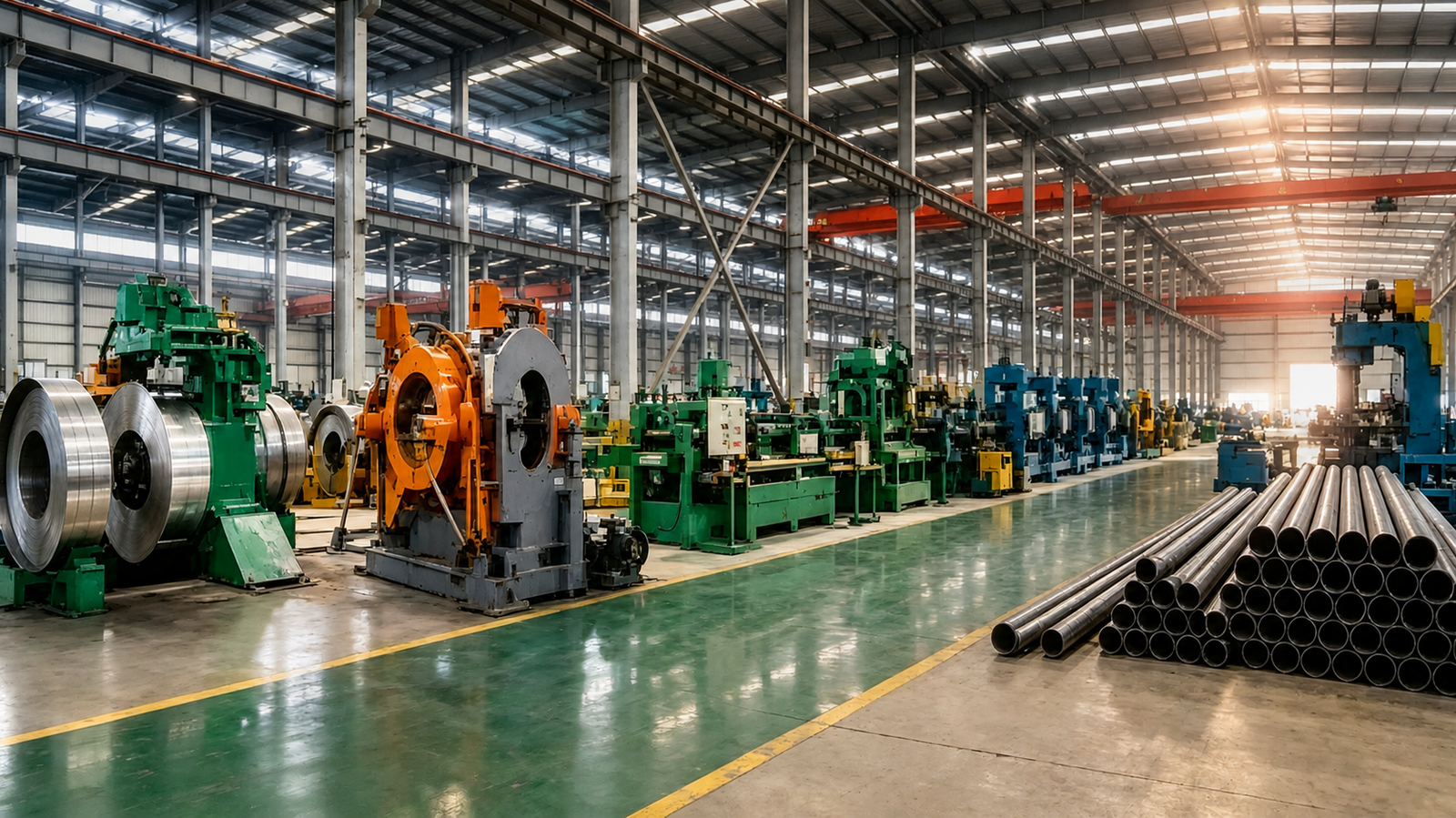
The modern ERW tube mill entry section is an integrated automated production unit composed of multiple precision mechanical, hydraulic, and electrical devices, tailored for continuous carbon steel, stainless steel, and alloy steel tube manufacturing. Different from traditional decentralized feeding equipment, the integrated entry section features compact structure, high automation, and stable operation, perfectly matching high-speed ERW tube mill line production requirements. Its core equipment configuration includes hydraulic un-coiler, coil peeler and hold-down device, strip flattener, hydraulic shear-butt welding machine, strip accumulator. Each device works in linkage to form a closed-loop continuous feeding system.
Every component of the entry section is designed to solve core pain points in tube production: coil uncoiling deviation, strip head warping, discontinuous material feeding, unstable tension, and inaccurate strip butt joint. It is an indispensable key unit for improving finished pipe roundness, weld seam uniformity, and production continuity in standard and heavy-duty ERW pipe production line systems.
2. Complete Operational Workflow of ERW Tube Mill Entry Section
The operation of the tube mill entry system follows a standardized, automated continuous process from coil loading to stable strip output, realizing uninterrupted feeding for downstream forming and welding sections. The complete workflow is divided into six core stages, with seamless linkage between each step:
2.1 Coil Loading and Positioning
First, the steel coil is transported to the working position of the hydraulic un–coiler via a coil car. The hydraulic expansion mandrel of the un-coiler accurately stretches and clamps the inner hole of the steel coil to fix the coil position, effectively preventing coil displacement and slippage during high-speed uncoiling. This step adapts to various coil specifications and meets the loading requirements of large-weight industrial steel coils.
2.2 Automatic Uncoiling and Strip Head Guiding
After coil fixation, the peeler and hold-down roll device starts automatically to peel open the strip head with internal stress rebound, flatten the warped strip head, and guide the steel strip into the subsequent straightening unit. The hold-down roll maintains constant pressure on the strip surface to avoid bouncing and deviation during uncoiling, ensuring stable initial feeding status.
2.3 Strip Leveling and Defect Removal
The uncoiled steel strip enters the multi-roller flattener to eliminate coil bending deformation, surface warping, and edge unevenness generated during coil storage and transportation. Precision leveling ensures the flatness and linearity of the strip, avoiding tube forming defects such as pipe body distortion and asymmetric weld seams in subsequent processes.
2.4 Hydraulic Shearing and Butt Welding
When finishing one steel coil and switching to a new coil, the hydraulic shear cuts off the uneven head and tail of the old and new strips to obtain flat and neat butt joint surfaces. Then the automatic butt welding machine completes seamless welding of the strip joint, realizing endless connection of steel strips. This process eliminates production shutdown caused by coil switching and greatly improves the continuous operation rate of the ERW tube mill line.
2.5 Strip Buffering and Accumulation
The welded steel strip enters the strip accumulator (horizontal spiral or table type), which is the core buffering equipment of the entry section. The accumulator stores a certain length of steel strip in a limited space, providing material buffer for coil switching and butt welding processes. It ensures that the downstream forming and welding sections maintain constant-speed feeding without stopping, realizing 24-hour uninterrupted production.
2.6 Constant-Tension Feeding and Output
With the cooperation of guide rollers and tension control devices, the entry section outputs the processed steel strip at a constant speed and stable tension to the tube forming section. Real-time tension adjustment avoids strip stretching or stacking, ensuring consistent feeding parameters for subsequent high-frequency welding and tube forming.
3. Working Principle of ERW Tube Mill Entry Section
The core working principle of the ERW tube mill entry section is based on mechanical transmission, hydraulic proportional control, and closed-loop electrical signal feedback, realizing automated, precise, and continuous strip pretreatment and feeding. Its operational logic focuses on three core dimensions: mechanical shaping, tension balance, and continuous material supply.
In terms of mechanical shaping, the un-coiler relies on hydraulic mandrel expansion to achieve rigid fixation of the steel coil, and the peeler mechanism uses mechanical pressure to eliminate the internal stress of the strip head. The multi-roller flattener adopts the principle of repeated elastic-plastic deformation to correct the geometric errors of the strip, ensuring that the strip output meets the flatness tolerance required for ERW tube forming.
In terms of tension balance, the entire entry section forms a dynamic tension control system through the cooperation of un-coiler braking, accumulator buffering, and guide roller speed regulation. The system automatically identifies strip feeding resistance and speed changes, dynamically adjusting uncoiling torque and feeding speed to keep the strip tension within the set constant range. This avoids quality problems such as strip thinning, deformation, and feeding deviation caused by excessive tension, or stacking and wrinkling caused by insufficient tension.
In terms of continuous material supply, the combination of butt welding machine and strip accumulator solves the industry pain point of intermittent production caused by coil switching. The accumulator stores excess strip during normal production and releases buffered strip during coil switching and welding, ensuring zero-stop production of the downstream ERW pipe making machine. The entire process realizes automated cycle operation without manual intervention, greatly improving production efficiency.
4. Hydraulic System of ERW Tube Mill Entry Section
El hydraulic system is the power core of the ERW tube mill entry section, providing stable and precise power support for all mechanical actions such as un-coiler expansion and contraction, hold-down roll lifting, hydraulic shearing, and welding positioning. The high-performance hydraulic system directly determines the operation stability and action precision of the entry section equipment.
4.1 Core Composition of Hydraulic System
The hydraulic system consists of hydraulic pump station, proportional pressure valve, solenoid directional valve, hydraulic cylinder, oil filter, cooling device, and pressure sensor. The integrated hydraulic pump station provides continuous and stable hydraulic power; the proportional valve accurately adjusts oil pressure and flow to realize stepless speed regulation and pressure regulation of hydraulic actions; the high-precision sensor monitors system pressure in real time to ensure safe and stable operation.
4.2 Main Functions and Working Advantages
First, it realizes hydraulic expansion and braking of the un-coiler. The hydraulic mandrel accurately expands and clamps steel coils of different inner diameters, and the hydraulic braking system provides stable uncoiling tension to prevent inertial runaway of the steel coil. Second, it powers hydraulic shearing and hold-down actions. The high-pressure hydraulic shear ensures flat and smooth strip cutting sections without burrs, improving butt welding quality. Third, it provides precise positioning power for the butt welding machine, ensuring accurate alignment of strip heads and tails and improving welding firmness and flatness.
In addition, the hydraulic system is equipped with overload protection and constant-pressure stabilization functions. When the equipment is overloaded or the oil pressure fluctuates abnormally, the system automatically cuts off the power and gives an alarm to avoid equipment damage and production safety accidents. Compared with pneumatic and mechanical transmission systems, the hydraulic system features stable power, low noise, small vibration, and high action precision, which is suitable for long-term high-intensity operation of high-speed tube mill entry system.
5. Electrical Control System of ERW Tube Mill Entry Section
El PLC electrical control system is the intelligent brain of the ERW tube mill entry section, realizing unified scheduling, automatic linkage, and precise parameter control of all equipment units. The modern intelligent electrical control system adopts modular design, with high integration, strong anti-interference ability, and simple operation, which is the key to realizing unmanned continuous production of the entry section.
5.1 System Core Configuration
The electrical control system takes industrial PLC as the core, matched with human-machine interface (HMI), frequency converter, tension sensor, displacement encoder, and intelligent alarm module. All equipment actions and operating parameters are uniformly controlled by the PLC system; the HMI touch screen realizes parameter setting, real-time data monitoring, and equipment operation control; the frequency converter adjusts the operating speed of each motor in real time to realize synchronous linkage of the entire line.
5.2 Core Control Functions
First, automatic linkage control. The PLC system presets the entry section operation program to realize one-key automatic operation of coil loading, uncoiling, leveling, shear-end welding, and accumulating. Each equipment unit operates synchronously without manual single-step operation, improving production efficiency. Second, constant tension closed-loop control. The system collects real-time tension data through high-sensitivity sensors, feeds back to the PLC for intelligent calculation, and automatically adjusts uncoiling speed and hydraulic pressure to keep strip tension constant throughout the production process.
Third, intelligent fault diagnosis and protection. The electrical system monitors equipment operating current, temperature, pressure, and speed in real time. Once abnormal conditions such as material jamming, overload, and pressure loss occur, the system will automatically stop the machine and send an alarm prompt to avoid equipment failure and defective products. Fourth, parameter memory and remote adjustment. The system can store production parameters of different pipe specifications, realizing quick switching of production formulas and meeting the diversified production needs of ERW Tube Mill Line.
6. Technical Advantages and Application Value
The optimized ERW tube mill entry section integrates advanced hydraulic transmission and PLC intelligent control technology, with significant advantages in production stability, automation level, and product quality control. It effectively reduces manual operation errors, lowers equipment failure rates, improves the continuous operation rate of the entire tube mill line by more than 15%, and reduces defective pipe rates by about 20%. Suitable for mass production of carbon steel pipes, galvanized steel pipes, and stainless steel welded pipes, it is widely used in construction, pipeline transportation, mechanical manufacturing, and other industries, being the preferred supporting equipment for high-efficiency and high-precision ERW tube mill line worldwide.
Conclusión
As the essential upstream core unit of the ERW tube production system, the entry section’s equipment performance, operational stability, and control precision directly determine the overall production capacity and finished pipe quality of the entire line. The modern entry section equipped with advanced hydraulic systems and PLC electrical control system realizes full-process automation, precision control, and continuous production, solving multiple industry pain points in traditional tube mill feeding processes. For global tube manufacturing enterprises, selecting a high-quality tube mill entry system is a key measure to improve production efficiency, reduce production costs, and enhance product market competitiveness.
 English
  Español
  Русский
  العربية
  Français
  Português