1.Why Choose High-Precision End-Face & Chamfer Machining Matters for OCTG Pipes
Different from ordinary structural steel pipes, OCTG pipes bear extreme working conditions including high underground pressure, strong corrosion, and frequent mechanical tension and compression. The pipe end is the key connection part between tubular goods, and its machining accuracy directly affects the overall performance of oil and gas pipelines.
First, a flat and vertical pipe end-face ensures accurate pipe butt joint and perfect thread positioning in subsequent threading processes, effectively avoiding thread deviation, loose connection, and oil and gas leakage risks. Second, standardized inner and outer chamfers (usually 15°-45° customizable angles) eliminate sharp edges and burrs generated by pipe cutting, preventing scratch damage to sealing rings and thread surfaces during pipe assembly. Meanwhile, smooth chamfered ends greatly improve welding quality for on-site pipe connection, reducing welding defects and improving the overall structural stability of the pipeline.
Traditional manual or semi-automatic pipe end processing methods have prominent drawbacks: low machining efficiency, large manual error, inconsistent chamfer size and flatness of batch pipes, and serious residual burrs, which cannot meet the strict precision requirements of high-end OCTG products. The fully automated OCTG End-face & Chamfer Machine solves these industry pain points fundamentally, realizing standardized, high-precision, and batch intelligent processing of OCTG pipe ends.
2.Complete Working Principle of OCTG End-Face & Chamfer Machine
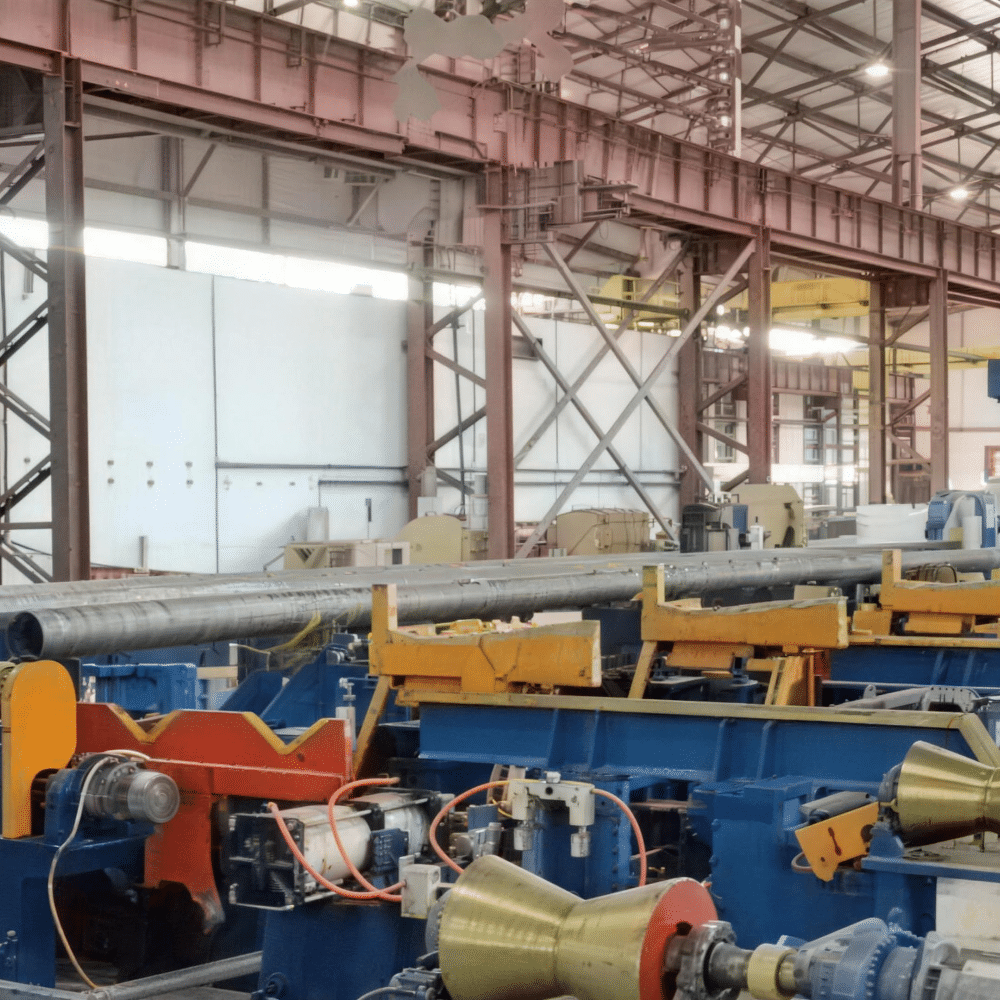
The OCTG end-face and chamfer machine adopts CNC servo automatic control technology, combining mechanical clamping, precise feeding, high-speed rotating cutting, and integrated deburring technology. It realizes one-time completion of pipe end flattening, inner chamfering, outer chamfering, and surface finishing through automated program setting. The whole working process is divided into six core links, with stable operation and fully automated unmanned production.
2.1 Automatic Pipe Feeding and Positioning
Matched with the front-end conveyor line of the OCTG production line, the equipment realizes automatic pipe feeding through the integrated stepping feeding device. Steel pipes are transported stably to the processing station by the conveyor system, and the blocking and positioning device accurately limits the pipe position to avoid axial and radial deviation. Equipped with real-time scanning detection modules, the machine can automatically identify pipe diameters and wall thicknesses, adaptively adjust positioning parameters, and complete precise centering of different specifications of OCTG pipes, laying a foundation for subsequent high-precision machining.
2.2 Hydraulic Stable Clamping
After positioning is completed, the high-precision hydraulic clamping system acts quickly to fix the pipe firmly. The clamping mechanism adopts a multi-point uniform stress design, which can avoid pipe deformation and surface scratch damage caused by excessive local clamping force. For thin-wall petroleum tubing and thick-wall casing, the system can automatically adjust clamping pressure according to pipe wall thickness and material hardness, ensuring no displacement during high-speed cutting and effectively guaranteeing the stability of machining accuracy.
2.3 Adaptive Tool Setting and High-Speed Cutting
The core cutting part adopts a high-rigidity spindle and multi-station composite cutter head structure. Driven by a variable-frequency AC motor, the spindle realizes stepless speed regulation (0-2000 RPM) to adapt to different steel materials such as carbon steel, alloy steel, and stainless steel for OCTG pipes. The servo motor drives the ball screw linear guide feeding system to achieve precise control of fast forward, working feed, and tool retraction strokes.
The machine adopts a multi-pass machining mode: rough machining removes excess residual materials and uneven burrs on the pipe end at a feed rate of 2-3 mm per pass; finish machining completes precise end-face flattening and standard chamfer forming at a low feed rate of 0.1-0.5 mm per pass. The composite cutter head integrates end-face turning tools, inner chamfer tools, and outer chamfer tools, realizing one-time clamping and synchronous completion of multiple processes, avoiding repeated positioning errors caused by multiple clamping.
2.4 Integrated Deburring and Surface Finishing
After cutting and forming, the built-in integrated brush deburring device automatically cleans micro burrs and metal chips on the pipe end and chamfer surface. Different from single manual deburring, the equipment’s synchronous deburring technology can completely remove tiny edge residues without damaging the pipe end machining accuracy, ensuring a smooth and flawless pipe end surface and meeting the high-standard surface finish requirements of high-end OCTG products.
2.5 Automatic Reset and Discharging
After all machining procedures are completed, the system automatically controls the cutter head to retract and the clamping mechanism to loosen. The stepping conveying device transports the processed qualified pipes to the rear-end sorting and storage area, and simultaneously completes the feeding and positioning of the next pipe, realizing continuous cycle operation of the production line and greatly improving production continuity.
2.6 Real-Time Quality Detection and Feedback
Equipped with a high-precision vision detection system, the equipment conducts real-time online detection of pipe end flatness, verticality, chamfer angle, and machining size. The detection accuracy reaches ±0.1° angle tolerance and ±0.02mm dimensional tolerance. Unqualified products will be automatically alarmed and marked, and the system can automatically compensate machining parameters according to detection data to ensure zero deviation of batch product quality.
3. Core Technical Highlights of OCTG End-Face & Chamfer Machine
Compared with ordinary pipe chamfering equipment on the market, our OCTG dedicated end-face and chamfer machine is optimized and upgraded for the high-standard production characteristics of petroleum tubular goods, with prominent technical advantages in precision, efficiency, stability, and adaptability, fully meeting the strict requirements of API international standards.
3.1 High-Precision Machining, Fully Compliant with API Standards
Aiming at the high precision requirements of OCTG pipe end finishing, the equipment adopts a high-rigidity integral bed and precision linear guide transmission structure, which effectively reduces equipment vibration during high-speed operation and avoids machining jitter errors. The CNC servo control system realizes micro-precision control of feed volume and cutting speed, ensuring pipe end verticality error ≤0.03mm/m, flatness error ≤0.02mm, and chamfer angle accurate and uniform. All machining indexes fully meet API 5CT and API 5B standards, perfectly matching the precision requirements of subsequent pipe threading and sealing assembly for oil and gas engineering.
3.2 Multi-Specification Adaptive Processing, Strong Compatibility
The equipment supports customized processing of multiple specifications of OCTG pipes, covering common petroleum tubing, casing, and drill pipe sizes. The chamfer angle is adjustable from 15° to 45°, and the spindle speed and feed rate can be intelligently adjusted according to pipe diameter, wall thickness, and material hardness. It can adapt to high-hardness alloy steel, carbon steel, and other special OCTG pipe materials, solving the problem that traditional single-function chamfering machines have poor adaptability and need frequent tool replacement and parameter adjustment. One device can meet the diversified production needs of factories and greatly reduce equipment procurement costs.
3.3 Integrated Intelligent Automation, Ultra-High Production Efficiency
The equipment adopts a fully automated one-stop processing design, integrating feeding, positioning, clamping, end-facing, chamfering, deburring, detection, and discharging. It does not need manual intervention in the whole process, realizing unmanned continuous production. Compared with traditional semi-automatic equipment, the production efficiency is increased by more than 60%, and the single-pipe processing cycle is greatly shortened. The independent CNC operating system supports one-click parameter setting and batch program storage, which is convenient for workers to operate and switch production specifications, effectively reducing labor costs and human error rates.
3.4 Stable and Durable Structure, Low Maintenance Cost
The whole machine adopts thickened steel plate welding and integral stress relief treatment, with strong structural rigidity and anti-vibration ability, adapting to long-term continuous high-load industrial production. Key components such as spindle, servo motor, and ball screw adopt international high-quality accessories, with stable performance and long service life. The equipment is equipped with a fully enclosed protective cover and an independent chip removal system, which can effectively isolate metal chips and dust, reduce equipment wear, and extend the service life of the machine. In addition, the modular design is convenient for daily maintenance and parts replacement, greatly reducing later operation and maintenance costs.
3.5 Safe and Environmentally Friendly, Meet Industrial Production Standards
The equipment is equipped with multiple safety protection devices such as emergency stop protection, overload alarm, and infrared induction anti-collision, which can automatically stop operation in case of abnormal equipment operation to ensure production safety. The built-in dust and chip collection system realizes centralized recovery of metal waste, no dust pollution in the production process, low operation noise, and compliance with international environmental protection and industrial safety production standards, helping enterprises achieve green and standardized production.
4. Industrial Application and Production Value
The OCTG end-face & chamfer machine is widely used in professional production lines of petroleum casing, tubing, drill pipe, and high-pressure gas transmission pipes. It is an essential supporting equipment for upstream precision finishing of OCTG products. For pipe manufacturers, the equipment can not only effectively improve the dimensional accuracy and surface quality of pipe ends, reduce product defective rate and rework cost, but also stabilize batch product consistency, help enterprises pass international standard certification, and enhance product competitiveness in the global high-end OCTG market.
In addition, the high-efficiency automated production mode greatly improves the production line operation efficiency, reduces manual dependence, and helps enterprises realize intelligent and upgraded automated production. Its strong specification adaptability also enables it to meet the customized processing needs of different customers and different engineering projects, with high industrial applicability and economic value.
5. Conclusão
As the core precision finishing equipment of the OCTG pipe production line, the end-face & chamfer machine relies on mature and stable working principles and advanced core technologies to solve the pain points of low precision, low efficiency, and poor consistency in traditional pipe end processing. With the advantages of API standard compliance, multi-specification adaptation, intelligent automation, stable operation, and low maintenance cost,
 English
  Español
  Русский
  العربية
  Français
  Português