

1. Why 80MPa+ High-Pressure Hydrostatic Testing Is Indispensable for Modern OCTG Production Lines?
Oil Country Tubular Goods (OCTG), covering casing, tubing, drill pipes and threaded couplings, form the critical load-bearing and sealing infrastructure for onshore and offshore oil and gas exploitation, ultra-deep well drilling, shale gas extraction and geothermal energy development. As global hydrocarbon exploration continues to advance toward deeper formations, high-pressure high-temperature (HPHT) reservoirs, sour gas fields and remote frontier blocks, regulatory and customer requirements for OCTG pressure resistance, structural integrity and threaded sealing performance have grown far more rigorous than ever before. Conventional low-pressure hydrostatic test units are no longer capable of verifying the safety margin of premium-grade OCTG grades including P110, Q125, C110, L80 and higher sour-service variants, creating a quality control gap that cannot be ignored by pipe manufacturers targeting export markets.
A high-pressure OCTG hydrostatic testing machine rated for working pressure of 80MPa and above has therefore evolved from an optional inspection tool into a mandatory core station on standardized, export-oriented OCTG production lines. It acts as the final quality gate for hot-rolled carbon steel, alloy steel and quenched-and-tempered tubular products, delivering pressure tightness verification in strict alignment with globally recognised specifications such as API Spec 5CT, the dominant standard for OCTG design and testing, alongside GOST 633-80 and GOST 31446-2017 widely adopted across the Commonwealth of Independent States (CIS).
This automated hydrostatic leak-testing system is purpose-built to assess the pressure-bearing capacity and sealing reliability of pipe bodies as well as threaded pipe-coupling joints, which represent the highest-risk failure point during downhole service. Under controlled high-pressure water medium, the machine exposes latent manufacturing defects that may escape visual inspection and non-destructive testing, including microscopic seepage, inconsistent wall thickness, localized material inhomogeneity, thread galling, improper thread make-up and sealing surface damage. If these flaws remain undetected, they can trigger catastrophic pipe burst, downhole leakage, well control incidents and costly production shutdowns once the OCTG string is lowered into the wellbore.
For steel mills and seamless pipe rolling enterprises focusing on high-end OCTG output, investment in an 80MPa+ hydrostatic tester delivers benefits extending beyond improved first-pass qualification rates. It enables consistent traceable test records, supports dual compliance with API international norms and GOST regional requirements, and removes a major technical barrier for product sales into Central Asia, Russia, the Middle East and other high-growth energy markets. Buyers in these regions increasingly demand on-site verification of hydrostatic test capability, complete test certificates and full audit trails before awarding long-term supply contracts. Without high-pressure hydrostatic testing capacity, manufacturers are restricted to low-grade, low-margin tubular products and excluded from large-scale national oil company tender projects.
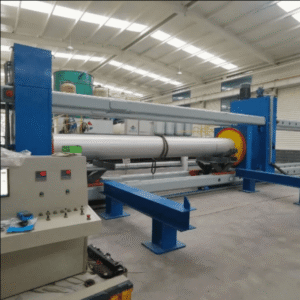
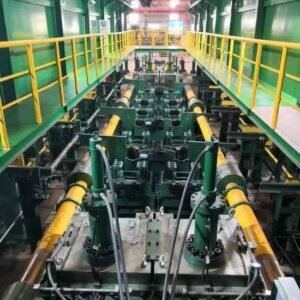
2. Working Principle of High-Pressure (≥80MPa) OCTG Hydrostatic Testing Machine
The automated high-pressure OCTG hydrostatic tester operates on the principle of static pressure hold with continuous real-time pressure acquisition, designed specifically to validate two core performance metrics: the burst resistance of the tubular body and the sealing integrity of threaded connections. Unlike dynamic fatigue testing, hydrostatic testing applies a controlled, steady hydraulic load using clean water as the test medium, which is non-flammable, cost-effective and suitable for large-volume serial testing. The entire sequence follows standardized test protocols defined by API and GOST, supporting unattended, continuous inline operation integrated directly after threading, marking and NDT stations on the pipe mill.
The workflow is engineered to accommodate all mainstream OCTG end configurations: plain-end pipes, external upset tubing (EUT), internal upset tubing (IUT), and combined upset designs. Every cycle follows five sequential, interlocked stages to eliminate human error and ensure repeatability.
Step 1: Automatic Pipe Positioning and End Sealing
After being conveyed from the upstream station, the target pipe is transported into the test chamber by roller tables or chain conveyors. Servo-driven sealing heads advance to seal both pipe ends reliably. Sealing modules are interchangeable to cover a wide range of OCTG outer diameters, and self-centering mechanisms guarantee concentric alignment, preventing seal extrusion and premature leakage during pressurization. For coupled pipe joints, special clamping fixtures secure the coupling area to avoid axial slip under high internal pressure.
Step 2: Water Filling and Air Purification
Clean filtered test water fills the pipe bore from the bottom port while trapped air is vented from the upper outlet. Complete air removal is critical: residual compressed air inside the pipe creates compressible pockets, which distort pressure readings, prolong pressure stabilization and introduce safety hazards. The system monitors exhaust until air-free water flows steadily out of the vent line before closing all drain and vent valves.
Step 3: Stepped High-Pressure Pressurization
The hydraulic booster unit raises internal pressure in programmed incremental steps rather than one rapid surge. Ramp rates are configurable according to standard requirements and pipe grade. Slow staged pressurization avoids shock loading, which could induce artificial damage to threads or base metal and produce false failure results. The control system compares actual pressure feedback against the target pressure curve at every interval.
Step 4: Constant Pressure Holding and Real-Time Monitoring
Once the specified test pressure is reached, the system enters the pressure hold phase for a preset dwell time, which varies by standard, pipe size and customer specification. High-precision pressure transmitters sample pressure continuously throughout the hold period. Any pressure drop exceeding the permitted threshold triggers an automatic fail alarm. Stable pressure retention confirms no leakage, while sustained pressure decay indicates a defective pipe body or threaded joint. All pressure-time data is captured synchronously.
Step 5: Pressure Relief, Water Drainage and Result Archiving
After successful completion of the hold cycle, the system executes slow, controlled depressurization to avoid water hammer. Test water is drained and recycled through the filtration loop for reuse. The control unit automatically tags the pipe as pass or fail, stores the full test log including pipe serial number, test pressure, hold duration and pressure curve, and generates a printable or digital test certificate for quality traceability. Failed pipes are marked and diverted to a rejection chute for re-inspection or scrapping.
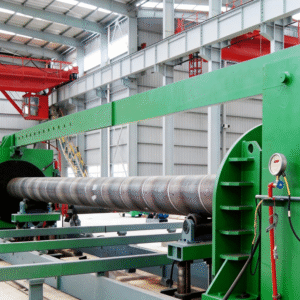

3. Complete Equipment Structure & Core Components
The 80MPa+ hydrostatic test machine is a tightly integrated mechatronic-hydraulic system, with each subsystem optimized to withstand cyclic ultra-high pressure and heavy continuous-duty operation.
3.1 Mechanical Transmission & Positioning System
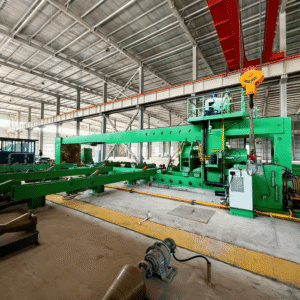
This subsystem comprises pipe conveying rollers, servo positioning carriages, end sealing actuators, heavy-duty clamping frames and safety guard structures. The frame must possess high rigidity to counteract enormous axial thrust generated by internal pressure. Safety interlock doors and perimeter guards stop the test cycle immediately if access is opened during pressurization, protecting operators from accidental water jet release. Quick-change sealing tooling allows fast switching between tubing, casing and special upset sizes to reduce product changeover time.
3.2 High-Pressure Water Supply & Filtration System
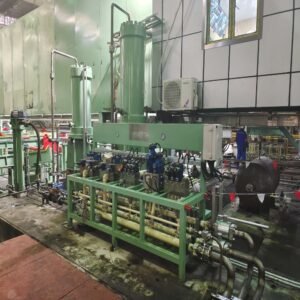
Test water quality directly affects seal service life and measurement stability. The circulation loop includes raw water tanks, coarse filters, fine cartridge filters and a cooling exchanger. Fine filtration removes sand, rust particles and machining swarf that would scratch sealing faces and cause micro-leaks. Recycled water lowers consumption and operational cost, while temperature control prevents thermal expansion effects from skewing pressure readings during long hold tests.
3.3 Hydraulic Power Drive System
This is the heart of the high-pressure unit. It consists of low-pressure hydraulic pumps, pressure intensifier boosters, high-pressure manifolds, check valves, relief safety valves and pressure sensing transmitters. The booster amplifies ordinary hydraulic pressure up to the 80MPa and above test range. All high-pressure piping, fittings and manifolds use forging-grade alloy steel with certified pressure ratings, subject to periodic inspection for fatigue cracking. Overpressure protection circuits are independently set to prevent overshoot beyond the pipe’s maximum allowable test pressure.
3.4 Intelligent Electrical Automation Control System
A PLC-based control platform with industrial HMI manages the full test sequence, parameter recipe storage, data acquisition, alarm management and report generation. Operators select pre-saved recipes for different pipe grades and standards (API or GOST) with one touch. The system supports network connection to the factory MES or quality management system, enabling centralized production data management, remote status viewing and batch traceability. Access permission levels prevent unauthorized modification of critical test parameters.
3.5 Auxiliary Support System
Auxiliary modules include compressed air supply for valve actuation, lubrication stations for moving parts, lighting and camera monitoring inside the test enclosure, and waste collection trays. Some customized configurations add automatic marking devices to stamp qualified pipes after testing, linking the hydrostatic station seamlessly with downstream stacking and packaging.
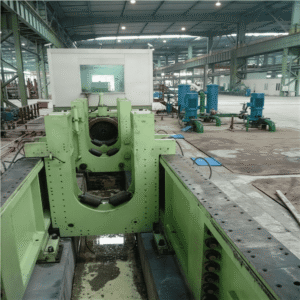
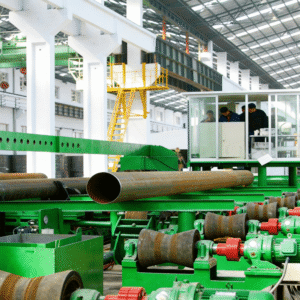
4. Core Advantages of High-Pressure Hydraulic System (80MPa+)
4.1 Ultra-High Pressure Stability & High Testing Precision
The booster hydraulic architecture maintains exceptionally flat pressure curves during dwell time, even at pressures above 80MPa. High-resolution pressure sensors deliver accurate, repeatable readings, eliminating the uncertainty common on older low-pressure test rigs. This precision is essential for premium OCTG, where even minor pressure drift can lead to disputed test results between mills and end buyers.
4.2 High Safety & Anti-Fatigue Operation
Cyclic ultra-high pressure imposes severe fatigue loading on all wetted and pressurized components. The system design incorporates conservative safety factors, burst discs, redundant relief protection and pressure decay interlocks. All high-pressure components undergo material certification and pre-commissioning proof testing. Slow ramp and depressurization routines minimize pressure shock, extending the service life of seals, manifolds and boosters and lowering unplanned downtime.
4.3 High Production Efficiency & Low Operating Cost
Fully automatic cycling reduces manual intervention. Once recipes are configured, the machine runs continuously at the pace of the pipe mill line. Recycled filtered water reduces water consumption, and efficient hydraulic booster designs cut power consumption compared with older direct high-pressure pump solutions. Rapid tool change between sizes further boosts throughput for mixed-size production orders. Over its service life, the unit reduces rework costs, warranty claims and rejection risks from downstream clients.
4.4 Strong Standard Compatibility & Line Adaptability
The control software supports configurable test parameters to satisfy both API 5CT and GOST requirements, as well as special additional specifications requested by national oil operators. The equipment can be built as standalone batch-test stations for small workshops or inline continuous stations integrated into high-speed seamless pipe production lines. This flexibility makes it suitable for new greenfield mills and retrofits alike.
5. Wide Industrial Application Scope
5.1 Professional OCTG Pipe Production Lines
Its primary deployment is within seamless pipe mills and threading plants manufacturing casing, tubing and coupling components for oil and gas service. Every finished OCTG string must pass hydrostatic verification before delivery, making this machine indispensable for serial high-grade tubular output.
5.2 CIS & Central Asian Energy Market Projects
Given widespread GOST standard adoption across Russia, Kazakhstan, Uzbekistan and neighbouring energy-producing nations, 80MPa+ hydrostatic test capability is a key tender prerequisite for local oilfield service companies and pipe suppliers. Manufacturers equipped with certified test records gain a decisive edge in these regional markets.
5.3 International Standard Energy Engineering Supporting
Beyond conventional onshore wells, the machine supports supply chains for offshore platforms, high-pressure sour reservoirs, CO₂ injection wells and geothermal projects, where design pressures far exceed those of conventional shallow wells. Engineering contractors require documented hydrostatic test evidence before accepting tubular deliveries for critical well construction.
5.4 Old Production Line Upgrading & Renovation
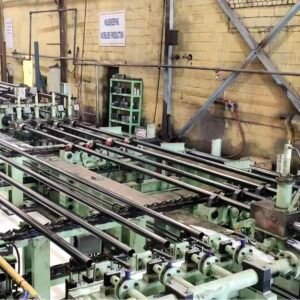
Many established pipe factories operate legacy hydrostatic rigs limited to lower pressure ranges. Retrofit upgrades with 80MPa+ booster packages and modern PLC control allow existing lines to upgrade product portfolios without constructing entirely new workshops. This is a cost-effective pathway for mills moving from commodity pipe into premium OCTG export business.
6. Conclusión
Whether for the construction of brand-new high-end OCTG production lines or intelligent transformation of ageing inspection stations, a high-pressure OCTG hydrostatic testing machine (≥80MPa) delivers robust, auditable quality assurance for steel pipe manufacturers. By meeting the dual compliance benchmarks of API international standards and GOST CIS regional specifications, it empowers manufacturers to consistently produce reliable, premium-grade casing and tubing. Reliable hydrostatic testing mitigates downhole operational risk, builds trust with global oilfield purchasers, opens access to high-value tender markets, and lays a solid foundation for long-term, stable cooperation with energy operators and engineering contractors across Central Asia, the Middle East and worldwide hydrocarbon basins. In an era of increasingly demanding deep and high-pressure well designs, this high-pressure test technology is not merely an inspection device, but a core competitive asset for OCTG exporters.
 English
 Español
 Русский
 العربية
 Français
 Português