Introducción
In the oil and gas industry, Oil Country Tubular Goods (OCTG) including casing, tubing, and couplings serve as the lifeline of downhole operations. As drilling ventures into deeper, high-pressure high-temperature (HPHT), and unconventional wells, standard API threaded connections can no longer meet stringent demands for sealing integrity, structural strength, and galling resistance. OCTG premium connections, featuring proprietary metal-to-metal seals, optimized thread profiles, and torque shoulder designs, have become the gold standard for critical applications.
Behind every high-quality premium connection lies a high-precision CNC threading machine. The performance, reliability, and service life of premium connections hinge directly on the threading machine’s specifications, precision, and compatibility. Selecting the right threading machine for OCTG premium connections is not just a procurement decision—it is a strategic choice that impacts production efficiency, product quality, operational safety, and total cost of ownership (TCO).
This comprehensive guide explores the core specifications, key selection criteria, and industry best practices for threading machines dedicated to OCTG premium connections. It integrates high-intent industry keywords, addresses common pain points, and provides actionable insights for manufacturers, oilfield service providers, and procurement professionals navigating the complex landscape of premium connection production.
What Are OCTG Premium Connections & Why They Matter
Definition & Core Advantages Over API Threads
OCTG premium connections are proprietary, high-performance threaded joints engineered to surpass the limitations of conventional API round (LTC/STC) and buttress (BTC) threads. Unlike API connections that rely on thread compound for sealing and exhibit lower resistance to high torque, bending, and corrosion, premium connections deliver:
- Gas-Tight Metal-to-Metal Seals: Radial or shoulder-type metal seals eliminate reliance on thread dope, ensuring zero leakage in HPHT and sour gas environments.
- High Tensile & Torque Capacity: Optimized thread geometry and interference fits enable connections to match or exceed pipe body strength, critical for deep and horizontal wells.
- Galling Resistance: Special surface treatments (phosphate coating, copper plating) prevent metal transfer during make-and-break cycles, extending service life.
- Torque Shoulder Mechanism: Provides positive make-up indication, prevents over-torque damage, and adds secondary sealing redundancy.
Common Types & Application Scenarios
Premium connections are categorized by design features, with the most widely used types including:
- Flush Joint Premium Connections: Slim-line, no external upset, ideal for restricted boreholes and horizontal wells.
- Semi-Flush Premium Connections: Balanced performance and cost, suitable for intermediate-depth casing and tubing.
- Integral Premium Connections: One-piece design without couplings, offering superior structural integrity for ultra-deep wells.
These connections are non-negotiable for deepwater drilling, shale gas extraction, HPHT reservoirs, and high-deviation horizontal wells, where connection failure can lead to catastrophic downhole accidents and massive financial losses.
Core Specifications of OCTG Premium Connection Threading Machines
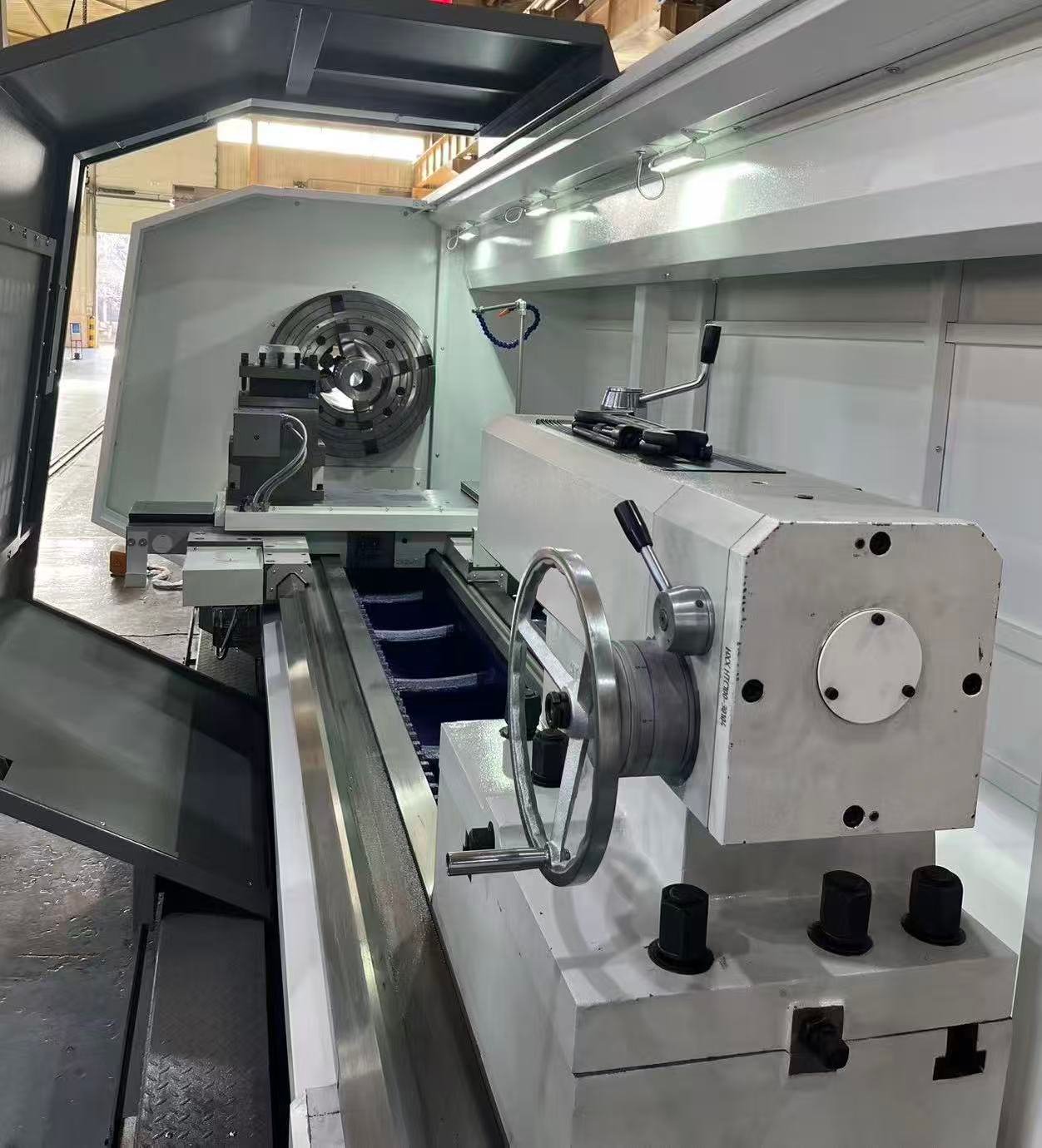
Premium connection threading demands micron-level precision, extreme rigidity, and multi-axis control—far beyond the capabilities of standard pipe threading machines. Below are the non-negotiable technical specifications that define a premium-grade threading machine:
1. Spindle System: The Heart of Precision
The spindle determines the machine’s ability to handle heavy-wall OCTG, maintain concentricity, and deliver consistent thread profiles.
- Spindle Bore Diameter: Must accommodate the maximum outer diameter (OD) of target OCTG, including upset ends. Common sizes:
- Φ200 mm: For tubing and light casing (up to 7” OD).
- Φ280 mm: For standard casing (up to 9-5/8” OD).
- Φ360 mm+: For heavy-wall and large-diameter casing (up to 13-3/8” OD).
- Spindle Rigidity & Vibration Damping: Heavy-duty cast iron construction, precision tapered roller bearings, and hydraulic cooling systems minimize vibration during high-speed threading—critical for preventing thread galling and ensuring surface finish.
- Speed Range: Variable speeds (50–1,000 RPM) to adapt to different steel grades (J55, N80, L80, P110, Q125) and thread profiles.
2. Axis Configuration & Travel
Premium connection threading requires simultaneous multi-axis movement to generate complex thread geometries, seal surfaces, and torque shoulders.
- Number of Axes: Minimum 4 axes (X, Z, C, Y) for standard premium connections; 5–7 axes for complex proprietary designs (e.g., wedge threads, double-shoulder seals).
- X-Axis Travel: ≥350 mm (14 in) for radial cutting of seal surfaces and thread profiles.
- Z-Axis Travel: ≥600 mm (23.5 in) for axial threading of full-length couplings and pipe ends.
3. Chuck System: Stability for Heavy Workpieces
Hydraulic chucks ensure secure, concentric clamping of OCTG during threading, eliminating deflection that causes thread misalignment.
- Dual Hydraulic Chucks (Front & Rear): 3-centering + 3-clamping jaws with 110 kN+ clamping force for concentric and floating operation—ideal for long couplings and heavy-wall pipe.
- Flip Chuck Design: Enables simultaneous machining of both coupling ends in a single setup, reducing cycle time and improving concentricity.
4. CNC Control System: Precision Programming
A high-end CNC system is essential for programming complex premium connection profiles, ensuring repeatability, and integrating automation.
- Brand Compatibility: FANUC, Siemens, or Mitsubishi CNC controllers with custom macro programming for proprietary thread designs.
- Precision Resolution: 0.001 mm positioning accuracy and 0.0001 mm repeatability to meet API 5B and premium connection tolerances.
- Built-In Thread Libraries: Pre-programmed cycles for common premium connections (e.g., VAM, TenarisHydril, OCTA) reduce setup time.
5. Tooling & Cutting Capacity
- Tool Holder Rigidity: Heavy-duty, vibration-dampening tool holders with quick-change capabilities for multiple cutting inserts.
- Material Compatibility: Ability to machine high-strength, alloyed steel grades (P110, Q125) and corrosion-resistant alloys (CRAs) used in sour service environments.
6. Automation & Productivity Features
Modern premium threading machines integrate automation to reduce labor costs, minimize human error, and maximize throughput.
- Automatic Loading/Unloading: Robotic or hydraulic feeders for continuous production of couplings and pipe ends.
- In-Process Inspection: Integrated laser or probe systems for real-time measurement of thread pitch, taper, and seal surface dimensions.
- Low TCO Design: Energy-efficient motors, minimal tool wear, and predictive maintenance capabilities reduce operational costs over the machine’s lifecycle.
Key Selection Criteria for OCTG Premium Connection Threading Machines
Selecting the optimal threading machine requires aligning technical specifications with production goals, workpiece requirements, and long-term business objectives. Below are the critical factors to evaluate:
1. Workpiece Compatibility: Match Machine to OCTG Specifications
- Pipe OD & Weight Range: Ensure the spindle bore, chuck capacity, and axis travel can handle your target OCTG sizes (e.g., 2-3/8” to 13-3/8” couplings) and wall thicknesses.
- Steel Grade & Hardness: Verify the machine’s spindle power, torque, and tooling compatibility with high-strength (Q125) or CRA materials.
- Connection Type: Confirm the CNC system supports programming for your required premium connection designs (e.g., metal-to-metal seal, torque shoulder, wedge thread).
2. Precision & Quality Assurance: Non-Negotiable for Premium Connections
- Positioning Accuracy & Repeatability: Prioritize machines with ≤0.001 mm positioning error and ≤0.0001 mm repeatability to meet strict premium connection tolerances.
- Vibration Damping: Low-vibration design is critical for preventing thread galling, ensuring smooth surface finishes, and extending tool life.
- API & Premium Certification: Select machines certified to API 5B/5CT standards and validated for premium connection production by reputable oilfield operators.
3. Production Volume & Efficiency: Balance Speed & Consistency
- High-Volume vs. Low-Volume Production:
- High-Volume (100,000+ couplings/year): Choose rotary threading machines with dual chucks, automatic loading/unloading, and simultaneous end machining (e.g., Danieli PCTM-13, SMS RMG series).
- Low-to-Medium Volume: Opt for compact, flexible CNC lathes with multi-axis capability for quick changeovers between connection types.
- Cycle Time: Evaluate machining time per coupling/pipe end—faster cycles without compromising precision directly boost profitability.
4. Automation Level & Labor Costs
- Manual vs. Semi-Automatic vs. Fully Automatic:
- Fully Automatic: Best for high-volume facilities; minimizes labor intervention, reduces human error, and enables lights-out production.
- Semi-Automatic: Balances cost and flexibility for mid-volume operations.
- Manual: Only suitable for prototyping or small-batch, custom premium connections.
5. Total Cost of Ownership (TCO): Look Beyond Purchase Price
The upfront cost of a premium threading machine is only 20–40% of its TCO over a 10–15 year lifespan. Evaluate:
- Energy Consumption: Energy-efficient motors and hydraulic systems reduce electricity costs.
- Tool Wear & Maintenance: Low-vibration design extends tool life; easy-access components and predictive maintenance features minimize downtime.
- Spare Parts & Support: Choose manufacturers with global service networks, readily available spare parts, and comprehensive operator training.
- Resale Value: Reputable brands (EMAG, SMS Group, Danieli) retain higher resale value than generic alternatives.
6. Manufacturer Reputation & Technical Support
- Experiencia en el sector: Select suppliers with a proven track record in OCTG premium connection threading (e.g., EMAG, SMS Group, Danieli, PMC-Colinet).
- Customization Capability: Ensure the manufacturer can customize the machine’s CNC programming, tooling, and automation to match your specific premium connection designs.
- After-Sales Service: 24/7 technical support, on-site installation, operator training, and maintenance contracts are critical for minimizing downtime in oilfield operations.
Common Challenges & Mitigation Strategies
Even with careful selection, manufacturers may face challenges in premium connection threading. Below are the most common issues and actionable solutions:
1. Thread Galling & Surface Defects
- Cause: Excessive vibration, insufficient tool cooling, or poor chuck concentricity.
- Mitigation: Select low-vibration machines; use high-performance cutting fluids; ensure precise chuck alignment; apply anti-galling coatings (phosphate, copper) post-threading.
2. Dimensional Inconsistency
- Cause: Inadequate spindle rigidity, CNC programming errors, or worn tooling.
- Mitigation: Choose heavy-duty spindle designs; validate CNC programs with trial runs; implement regular tool inspection and replacement schedules.
3. High Production Costs
- Cause: Low automation, excessive tool wear, or unoptimized cycle times.
- Mitigation: Invest in semi/full automation; select low-vibration machines to extend tool life; optimize CNC programs for faster, efficient machining.
4. Compatibility Issues with Proprietary Connections
- Cause: CNC system lacks pre-programmed cycles for niche premium connection designs.
- Mitigation: Partner with manufacturers offering custom macro programming; collaborate with connection licensors (e.g., Tenaris, VAM) for technical support.
Conclusión
OCTG premium connections are indispensable for modern oil and gas exploration, delivering the reliability and performance required for deep, HPHT, and unconventional wells. The máquina de roscado is the cornerstone of premium connection production, with its specifications, precision, and automation capabilities directly determining product quality, production efficiency, and TCO.
Selecting the right threading machine requires a holistic approach: aligning spindle and axis specifications with workpiece requirements, prioritizing micron-level precision and vibration damping, balancing automation with production volume, and evaluating long-term TCO over upfront cost. Partnering with reputable manufacturers that offer customization, technical support, and industry expertise ensures a seamless integration of the machine into your production workflow.
As the oil and gas industry continues to evolve, with deeper wells and more demanding downhole environments, the demand for high-quality OCTG premium connections will only grow. By investing in the right threading machine today, manufacturers can position themselves for success in a competitive market, delivering premium connections that meet the highest industry standards and drive operational excellence for oilfield operators.
 English
  Español
  Русский
  العربية
  Français
  Português