Resumen
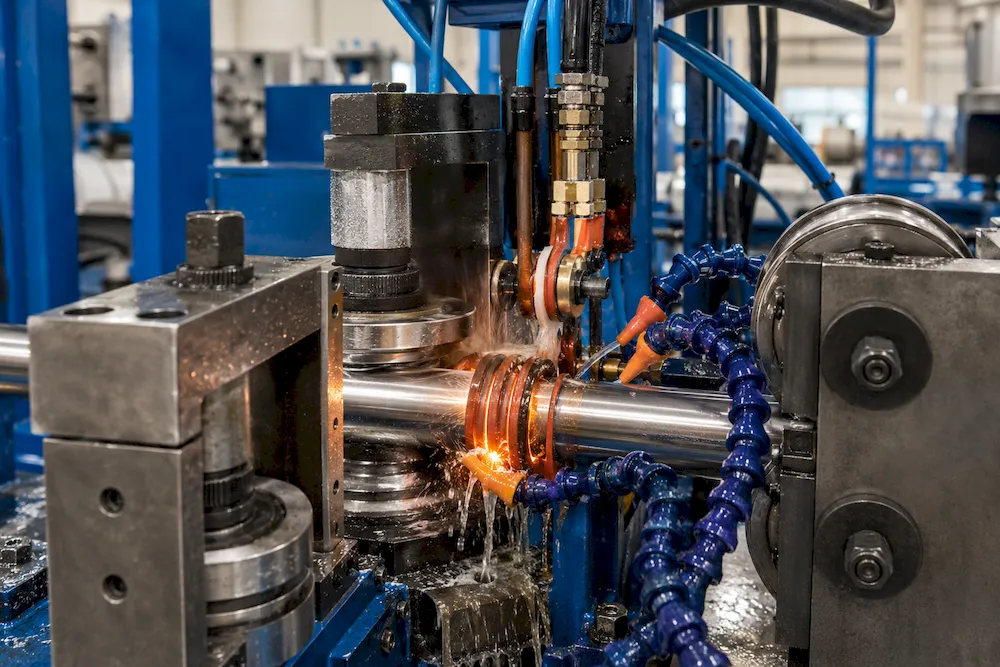
In ERW tube production, the high-frequency welder is one of the most important machines in the whole line. It is used to weld the two edges of the steel strip together after the strip is formed into a tube shape.
ERW means Electric Resistance Welding. In this process, the steel strip is not welded by a traditional welding rod. Instead, the machine uses high-frequency current to heat the strip edges. Then the heated edges are pressed together to create a strong weld seam.
This welding method is widely used in steel tube and pipe production because it is fast, stable, and cost-effective. For many pipe factories, a good high-frequency welder can improve production speed, product quality, and long-term business value.
In this article, we will explain the top benefits of using a high-frequency welder in ERW tube production.
What Is a High-Frequency Welder?
A high-frequency welder is a machine that uses high-frequency electrical current to heat metal edges. In an ERW tube mill line, it is used after the forming section.
At this stage, the flat steel strip has already been formed into a round tube shape. The two edges of the strip are very close to each other, but they are not joined yet. The high-frequency welder heats these two edges quickly. Then squeeze rollers press the edges together.
After cooling, the edges become one welded seam.
Why It Is Important in ERW Tube Production
The weld seam is the most important part of an ERW tube. If the weld seam is weak, the tube may fail during use. If the weld seam is stable and strong, the final pipe can be used in many industries with confidence.
This is why the high-frequency welder is not just an ordinary machine. It directly affects the quality, strength, and production efficiency of the whole ERW tube mill line.
Benefit 1: High Production Speed
One of the biggest benefits of a high-frequency welder is fast welding speed. In ERW tube production, speed is very important because many factories need to produce large quantities of tubes every day.
High-frequency welding can heat the strip edges in a very short time. The tube can move continuously through the production line while welding is happening.
This helps factories increase output and reduce waiting time.
Why Speed Matters
When production speed is higher, the factory can complete more orders in less time. This is very helpful for large projects, repeat orders, and bulk production.
Fast production can also reduce labor cost per meter of tube. For pipe manufacturers, this can improve profit and market competitiveness.
Benefit 2: Stable Weld Seam Quality
A good high-frequency welder can provide stable welding energy. This helps create a consistent weld seam along the full length of the tube.
In tube production, consistency is very important. Customers do not only need one good pipe. They need every pipe to meet the required standard.
High-frequency welding helps improve this stability.
What Makes a Good Weld Seam?
A good weld seam should be strong, smooth, and uniform. It should not have cracks, holes, or weak areas.
Good weld seam quality depends on many factors, including:
- Stable welding power
- Correct welding temperature
- Good strip edge condition
- Proper squeeze pressure
- Accurate forming before welding
- Correct machine adjustment
The high-frequency welder plays a key role in controlling welding heat and energy.
Benefit 3: Lower Production Cost
High-frequency welding is a cost-effective welding method. In many cases, it does not need extra welding wire or filler material. The machine uses the steel strip edges themselves to create the weld.
This helps reduce material cost.
Also, because the welding speed is fast, the factory can produce more tubes with the same production time. This can reduce the average cost of each pipe.
Cost Savings for Pipe Manufacturers
A high-frequency welder can help reduce cost in several ways:
- Less need for welding consumables
- Higher production speed
- Lower labor cost per product
- Less production downtime
- Better product consistency
- Lower waste when the line is well controlled
For a factory that produces tubes every day, these savings can become very important over time.
Benefit 4: Suitable for Continuous Production
An ERW tube mill line is designed for continuous production. The steel strip moves from the uncoiler to the flattener, shear end welder, accumulator, forming section, welding section, sizing section, cutting machine, and packing system.
The high-frequency welder fits this continuous process very well.
It can weld the tube while the tube is moving. The line does not need to stop for every weld. This makes the whole production process smooth and efficient.
Why Continuous Production Is Useful
Continuous production improves factory efficiency. It reduces machine idle time and helps keep the production line stable.
For factories with large orders, this is a major advantage.
Benefit 5: Good for Many Tube Sizes
High-frequency welders can be used for many types of ERW tubes. They are suitable for different tube diameters, wall thicknesses, and product applications.
With the right machine power and correct mill design, high-frequency welding can support both small tubes and larger pipes.
Common Products Made with High-Frequency Welding
High-frequency welders are often used to produce:
- Tubos redondos de acero
- Tubos de acero cuadrados
- Tubos rectangulares de acero
- Tubos estructurales
- Tubos para muebles
- Tubos para andamios
- Tubos para la industria automovilística
- Tuberías industriales
- Oil and gas related pipes
This flexibility makes the high-frequency welder a useful choice for many steel pipe factories.
Benefit 6: Cleaner Welding Process
High-frequency welding is a relatively clean process. Since it usually does not need welding rods or filler wire, there is less welding material waste.
The process can also create a neat weld seam when the machine is properly adjusted.
This is helpful for factories that want better surface quality and less post-processing work.
Less Extra Work After Welding
After welding, the outside weld bead is usually removed by a scarfing tool. Then the tube enters the sizing section to improve shape and accuracy.
When welding is stable, the following process becomes easier. The tube surface is better, and the line can run more smoothly.
Benefit 7: Strong Weld Seam Performance
High-frequency welding can create a strong weld seam when the process is correctly controlled. The heated strip edges are pressed together under pressure, so the metal joins firmly.
This is important for tubes used in structural, industrial, and transportation applications.
A strong weld seam helps the tube handle load, pressure, bending, and long-term use.
Important for Safety and Reliability
In many applications, tube failure can cause serious problems. For example, pipes used in construction, machinery, or oil and gas systems must be reliable.
Good welding quality helps reduce product risk and improve customer trust.
Benefit 8: Better Energy Efficiency
Compared with some traditional heating methods, high-frequency welding can be more energy efficient because the heat is focused on the strip edges. The machine does not need to heat the whole tube body.
This focused heating helps save energy and improve welding speed.
For factories with long daily operation hours, better energy efficiency can reduce operating cost.
Focused Heating Is the Key
The high-frequency current mainly heats the edges that need to be welded. This makes the process fast and effective.
Less wasted heat means better use of energy.
Benefit 9: Easy to Combine with Automation
Modern high-frequency welders can work together with control systems, sensors, and automatic production equipment. This makes it easier to control welding parameters and monitor the production process.
Automation helps reduce human error and improve product stability.
Common Parameters to Control
During production, operators may need to control or monitor:
- Welding power
- Line speed
- Temperatura de soldadura
- Cooling condition
- Presión de compresión
- Machine status
With a good control system, the factory can manage these details more easily.
Benefit 10: Improves Overall Tube Mill Line Performance
The high-frequency welder does not work alone. It works together with the whole ERW tube mill line.
If the welder is stable, the forming section, sizing section, cutting section, and packing section can also work more smoothly. If the welder has problems, the whole line may slow down or stop.
This means a reliable high-frequency welder can improve the performance of the complete production line.
One Machine Can Affect the Whole Line
In continuous tube production, every section is connected. A problem in one section can affect all other sections.
That is why choosing a good high-frequency welder is important for long-term production success.
How to Choose a High-Frequency Welder for ERW Tube Production
When choosing a high-frequency welder, buyers should not only look at price. They should also consider production needs, pipe size, wall thickness, material, line speed, and long-term service support.
Key Points to Consider
- Tube diameter range
- Tube wall thickness
- Steel material type
- Required production speed
- Welder power
- Control system
- Cooling system
- Maintenance requirements
- Supplier experience
- After-sales support
The right welder should match the whole tube mill line. It should not be too small for the production requirement. It should also not be too large if the factory only needs a simple production line.
Common Problems If the Welder Is Not Stable
If the high-frequency welder is not stable, many production problems may happen.
For example, the weld seam may become weak or uneven. The tube surface may have more defects. The line may need frequent stops for adjustment. In serious cases, the factory may produce many rejected pipes.
Possible Problems Include
- Unstable weld seam
- Poor welding strength
- Overheating or underheating
- More scrap pipes
- Lower production speed
- Higher maintenance cost
- Customer quality complaints
For this reason, investing in a reliable high-frequency welder is usually a smart decision.
Conclusión
A high-frequency welder is a key machine in ERW tube production. It heats the strip edges quickly and helps create a strong welded seam. Without a stable welder, it is difficult to produce high-quality ERW tubes continuously.
The main benefits of using a high-frequency welder include high production speed, stable weld quality, lower production cost, clean welding, strong weld seam performance, better energy efficiency, and easy automation.
For steel pipe manufacturers, the welder is not just one part of the production line. It is one of the core machines that decides the final pipe quality and production efficiency.
When choosing a high-frequency welder, factories should consider tube size, wall thickness, material, production speed, welder power, control system, and supplier support. A well-matched high-frequency welder can help the ERW tube mill line run faster, safer, and more reliably.
In the long run, it can help the factory produce better pipes, reduce cost, and win more customer trust in the market.
 English
  Español
  Русский
  العربية
  Français
  Português